
Home / Blog / Bone china vs porcelain
Guide · House Materials
Bone china vs porcelain: the invisible difference that changes your dinnerware
A serene guide on composition, translucency, resistance, and care: what is seen, what is felt in the hand, and what truly decides a good purchase.
Mesa Real · House Editorial · July 29, 2026 · 13 min
Quick answer Bone china is typically lighter, thinner, more translucent, and warmer in tone because it incorporates calcined bone ash. Porcelain usually offers a cooler white, a more solid feel, and enormous versatility for everyday use. Neither is better in all cases: the right choice depends on the collection, the rim design, the decoration, the frequency of use, and the possibility of replacing pieces. Bone chinaBone ash, lightness, and marked translucency Hard-paste porcelainKaolin, vitrification, and an especially hard surface Best choiceDepends on the collection, the rim, the decoration, and the use Decisive factThe official spec sheet is worth more than the commercial label
Choosing between bone china and porcelain should not be reduced to the idea that one is “luxury” and the other “common.” There are extraordinary hard-paste porcelains produced by historic manufacturers, just as there are bone china pieces whose main advantage is aesthetic and not necessarily operational. The material matters, though it never acts alone.
This guide compares both materials without confusing them with ceramics or earthenware, topics that deserve a separate analysis. To explore available collections and pieces, visit our selection of porcelain dinnerware and plates.
In this guide
- What bone china really is
- What we mean by porcelain
- Direct comparison
- Which material is more resistant
- Which one is best depending on use
- Dishwasher, microwave, and care
- How to choose before buying
- Frequently asked questions
What is bone china and why does it contain bone ash?
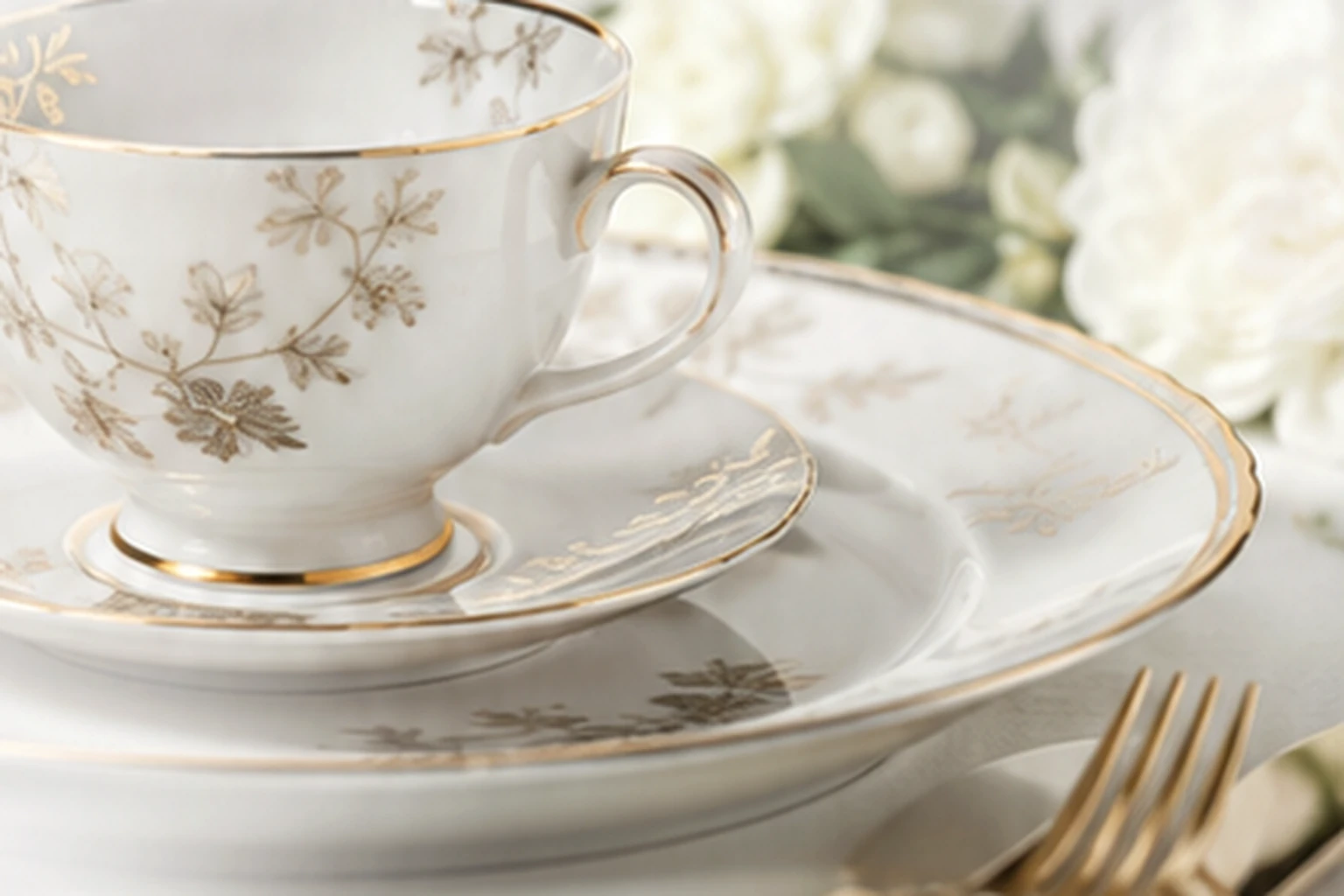
Bone china is a fine, translucent ceramic related to porcelain. The Victoria and Albert Museum describes it as a form of porcelain that incorporates bone ash into its composition. Its defining feature is the addition of calcined bone ash to a mixture that may also include kaolin and feldspathic materials. The bone is subjected to high temperatures until it transforms into a phosphate-rich mineral matter; it is not incorporated into the piece in its original organic state.
Traditional British formulations can contain a high proportion of bone ash. Some industrial references place the minimum for fine bone china at around 30% phosphate derived from calcined bone, although the exact composition varies by manufacturer, country, and the standard used. Therefore, a brief commercial description is no substitute for a technical data sheet.
The ash modifies the microstructure of the ceramic body. The usual result is a piece that is:
- thinner and lighter in relation to its size;
- more translucent when held up to a light source;
- ivory white, cream, or slightly warm in color;
- characterized by a clear ring when tapped very gently;
- capable of combining a delicate appearance with considerable mechanical strength.
An important clarification: traditional bone china contains material of animal origin. For vegan buyers, or for those following ethical or religious restrictions, this point should be verified before purchase. Terms such as “new bone china” do not, on their own, guarantee a specific composition.
What do we mean by porcelain?
Porcelain is a vitrified, white, hard ceramic with very low porosity. Hard-paste porcelain is typically produced with a combination of kaolin, feldspar, and quartz, fired at high temperatures. Vitrification creates a compact, stable body suitable for long-lasting tableware pieces.
Not all porcelain is identical. The recipe, the purity of the raw materials, kiln control, thickness, glaze, and the geometry of the piece can significantly modify the result. A reinforced hotel porcelain cup, a fine porcelain plate for a formal dinner, and a decorative figurine share a material family, but they have not been designed to withstand the same use.
In the hand, porcelain usually conveys a more solid feel. Its white can be brighter or cooler than that of bone china, although the actual tone depends on the composition and the glaze. Fine pieces can also show translucency, but normally in a less marked way than a bone china of comparable quality.
Bone china vs porcelain: direct comparison
| Criterion | Bone china | Porcelain |
|---|---|---|
| Composition | Includes calcined bone ash, in addition to ceramic components. | Based primarily on mineral materials such as kaolin, feldspar, and quartz. |
| Color | Warm white, ivory, or cream. | More neutral, bright, or slightly cool white. |
| Translucency | Generally high, especially at thin edges. | Can be translucent, although it usually lets less light through. |
| Weight | Usually feels lighter and thinner. | Usually feels more solid and dense. |
| Strength | Can offer very good toughness and chip resistance despite its fineness. | Can provide great surface hardness, stability, and resistance in intensive use. |
| Scratches | The glaze on some pieces may mark more easily. | Quality hard porcelain usually offers a surface highly resistant to wear. |
| Aesthetics | Ethereal, luminous, refined, and warm. | Sharp, versatile, architectural, or classic depending on the design. |
| Price | Often higher due to process, positioning, and fineness. | Wide range: from everyday use to collectible manufacturing. |
| Animal origin | Yes, in the traditional formulation. | Does not require bone ash. |
| Frequent use | Suitable when the manufacturer declares it fit and the design is not excessively delicate. | Very versatile for home, gastronomy, and hospitality depending on specification. |
The light test: useful, but not infallible
Holding a piece up to a strong light allows you to observe translucency. In bone china, the shadow of fingers behind the wall is usually seen more easily. The test helps compare two pieces, but it does not certify the material on its own. A very fine porcelain can also be translucent, while a thick piece of bone china may let less light through.
Color: warm white vs. crisp white
The ivory hue of bone china works especially well with candlelight, warm metals, gold flatware, and ecru textiles. White porcelain creates a sharper contrast with intensely colored foods and integrates easily into contemporary, minimalist, or professional tablescapes.
Neither of these tones inherently demonstrates superior quality. The ideal white depends on the atmosphere, lighting, glassware, and the complete table composition.
Which is more durable: bone china or porcelain?
The responsible answer is: it depends on what type of resistance is being measured and how the piece is designed. "Durable" can mean withstanding bending, avoiding edge chipping, resisting scratches, tolerating temperature changes, or surviving thousands of dishwasher cycles. These properties do not always advance together.
Comparative material studies have observed higher fracture toughness and lower brittleness in certain commercial bone china samples compared to hard-paste porcelain. This structure helps explain why a very thin piece can withstand small impacts on the edges well. At the same time, research on whiteware indicates that some bone china glazes may scratch more easily than those of hard-paste porcelain.
This leads to a conclusion more useful than any slogan:
- Thinness does not automatically mean fragility.
- Thickness does not automatically guarantee strength.
- A rounded edge usually tolerates impacts better than a very sharp profile.
- A poorly polished base can scratch stacked pieces, even if the body is excellent.
- The glaze, the decoration, and daily handling can determine the lifespan more than the name of the material.
For homes, the practical difference usually appears in the way they are used. For restaurants and hotels, stackability, the weight of a full stack, replacement speed, and compatibility with industrial equipment also count. Our guide to dinnerware for restaurants and hotels develops those operational criteria separately.
Which one is right for your table?
The decision improves when starting from the actual occasion rather than an abstract hierarchy between materials.
- For a formal table, a tea service, or a wedding gift: bone china offers a light, luminous, and ceremonial feel. Its translucency is especially appreciated in cups, dessert plates, and thin-walled pieces.
- For a main daily-use set: a premium porcelain from a stable collection usually provides a very balanced combination of aesthetics, maintenance, and replacement availability.
- For a white and minimalist table: crisp white porcelain creates a clean backdrop for food, clear glassware, and steel or silver flatware.
- For warm and classic environments: the ivory tone of bone china harmonizes with gold, brass, dark wood, candles, and natural textiles.
- For restaurants, hotels, or events: it is advisable to prioritize professional collections, documented resistance, stackability, industrial washing, and open-stock availability. The nominal material is only the starting point.
- For buyers who avoid animal products: mineral porcelain is the direct alternative. The composition should be verified when the product is marketed under ambiguous names.
Is it worth having both?
In a table setting built over time, it can indeed make sense. Porcelain can form the main service, while bone china appears in tea, coffee, dessert, or a collection intended for celebrations. It is not necessary for all pieces to share the same material to create coherence; they can be united through color, proportion, decoration, or the same family of flatware.
To see how plates, flatware, glassware, and textiles coordinate, consult The art of entertaining with distinction.
Dishwashers, microwaves, and care: the decoration matters as much as the body
It should not be assumed that all bone china requires hand washing or that all porcelain can withstand any use. Many modern collections are designed for dishwashers and microwaves. The official guides from Villeroy & Boch confirm this possibility for many of their lines, but they do not turn the recommendation into a universal rule. However, the manufacturer's specific instructions always prevail.
Dishwasher
When the collection is authorized for mechanical washing, use a moderate program, prevent pieces from touching, and respect the detergent dosage. A significant portion of chipping occurs while loading or unloading the machine, not during the cycle.
Overglaze decorations, hand painting, antique pieces, and metallic rims may require hand washing. The Wedgwood bone china guide is a useful reference for understanding why care must be checked collection by collection. Even when a piece is technically suitable, aggressive cycles can accelerate the visual wear of the decoration.
Microwave
Pieces with gold, silver, or other metallic details should not be placed in the microwave unless expressly indicated by the manufacturer. This rule depends on the decoration, not on whether the body is bone china or porcelain.
Stacking and gray marks
Place soft separators between delicate pieces during prolonged storage. Do not slide one plate over another. Gray lines caused by contact with flatware may be metal transfer onto the glaze rather than a crack, although the cleaning method must be adapted to the surface.
Care rule: Before purchasing dinnerware, check five details in each collection's specifications: dishwasher, microwave, oven, type of decoration, and replacement availability. A generic answer about "porcelain" is no substitute for those specifications.
Why does bone china usually cost more?
Bone china usually occupies a high-end segment due to the selection of raw materials, process control, the difficulty of consistently producing thin walls, and the tradition associated with the material. However, the final price of dinnerware also incorporates:
- the reputation and origin of the manufacturer;
- the complexity of the mold and relief;
- the manual application of gold, platinum, or paint;
- the number of firings;
- production in small series;
- the availability of individual pieces;
- packaging, importation, and replacement service.
For that reason, a hard-paste porcelain that is signed and hand-decorated can cost considerably more than industrial bone china. The material helps explain the price, but does not determine it on its own.
How to choose without paying for a label
Before buying, compare the complete collection and not just a sample plate. A solid decision should answer these questions:
- What is the exact composition? Look for "fine bone china," "bone porcelain," "hard porcelain," or the manufacturer's technical designation.
- How does it feel in the hand? Evaluate weight, balance, rim thickness, and stability on the table.
- Does the white match your current pieces? Compare under natural light and warm light.
- How is the decoration applied? Gold or overglaze painting can change the care requirements.
- Can you buy each piece separately? Replacements prevent having to substitute an entire dinnerware set due to a single breakage.
- Will the collection remain available? Ask about continuity, lead times, and exact references.
- What uses does the manufacturer authorize? Dishwasher, microwave, oven, and thermal shock safety should appear in writing.
- Is the piece designed for your frequency of use? A monthly dinner and a hotel breakfast demand different specifications.
You can explore white plates, search for Villeroy & Boch pieces, or learn about the manufacturer's selection. Before linking a specific product to bone china, it is advisable to verify that the manufacturer's spec sheet confirms that material.
<!-- PRODUCT LINKS: Add 2–4 product cards only after verifying in the official source: 1) exact material; 2) dishwasher/microwave safety; 3) name and reference; 4) actual availability at Mesa Real. Do not label a piece as bone china if it is described only as "Premium Porcelain". -->
Conclusion: the best dinnerware is not the most delicate, but the one that corresponds to your way of experiencing the table
Choose bone china when looking for lightness, translucency, a warm white, and a refined presence. Choose porcelain when you value a crisp white, a more solid feel, great versatility, and an especially wide range for everyday or professional use.
Even so, do not buy a label. Compare the rim, the glaze, the decoration, the possibility of replacement, and the actual instructions of the collection. A good porcelain can accompany a family for decades, just as a well-chosen bone china can be used much more frequently than its delicate appearance suggests.
Bone china or porcelain for your table?
Tell us how many people will use the dinnerware, how often, what style you prefer, and what pieces you already own. Mesa Real can compare materials, collections, availability, and replacements before you make a decision.
Request advice Make an inquiry
Frequently asked questions about bone china and porcelain
Is bone china porcelain?
It is considered a fine translucent ceramic related to porcelain and, depending on the classification used, a form of soft-paste or hybrid porcelain. The essential difference is the calcined bone ash present in its composition.
Does bone china contain animal bones?
The traditional formulation does contain animal bone ash, typically bovine. The material is calcined and converted into a mineral component. Those who avoid animal products should request the exact composition.
Which is more durable, bone china or porcelain?
Quality bone china can offer high toughness and good chip resistance. Hard-paste porcelain can offer a particularly hard and stable surface. The actual result depends on the recipe, thickness, rim, glaze, firing, and use.
Is bone china suitable for everyday use?
Yes, when the collection was designed for frequent use and the manufacturer authorizes the intended washing method. Its fine appearance does not mean it must remain stored away, although delicate decorations may require more care.
Can bone china and porcelain go in the dishwasher?
Many modern collections can. Each reference must be checked. Gold, silver, hand-painting, certain overglaze decorations, and antique pieces may require hand washing.
Which is better for restaurants and hotels?
The best option is the collection that demonstrates durability, stackability, industrial dishwasher compatibility, food safety, and availability of replacements. Professional porcelain is commonly used, although some bone china lines can work in fine dining and luxury hospitality.
How to recognize authentic bone china?
Check the backstamp, the technical data sheet, and the manufacturer's designation. Translucency, light weight, and a warm white color are indicators, but they do not replace official documentation.
Why do some stores call bone china “fine china”?
It is often an imprecise translation from English. In Spanish, “porcelana china” can also be interpreted as porcelain manufactured in China. To avoid confusion, it is preferable to keep “bone china” or use “bone porcelain” along with the composition.
Continue exploring the art of the table
Category Porcelain dinnerware and plates Professional Guide How to choose dinnerware for restaurants and hotels Protocol The art of entertaining with distinction Editorial More Mesa Real guides
Sources consulted and editorial criteria
Mesa Real cross-references museum definitions, official manufacturer documentation, and technical literature. The properties indicated describe material trends; the instructions for the specific reference always prevail.