
SILVERSMITHS
Puiforcat, Christofle, Odiot, Ercuis (France); Georg Jensen (Denmark); Buccellati (Italy); Asprey, Garrard (UK); Tiffany & Co., Gorham (USA).
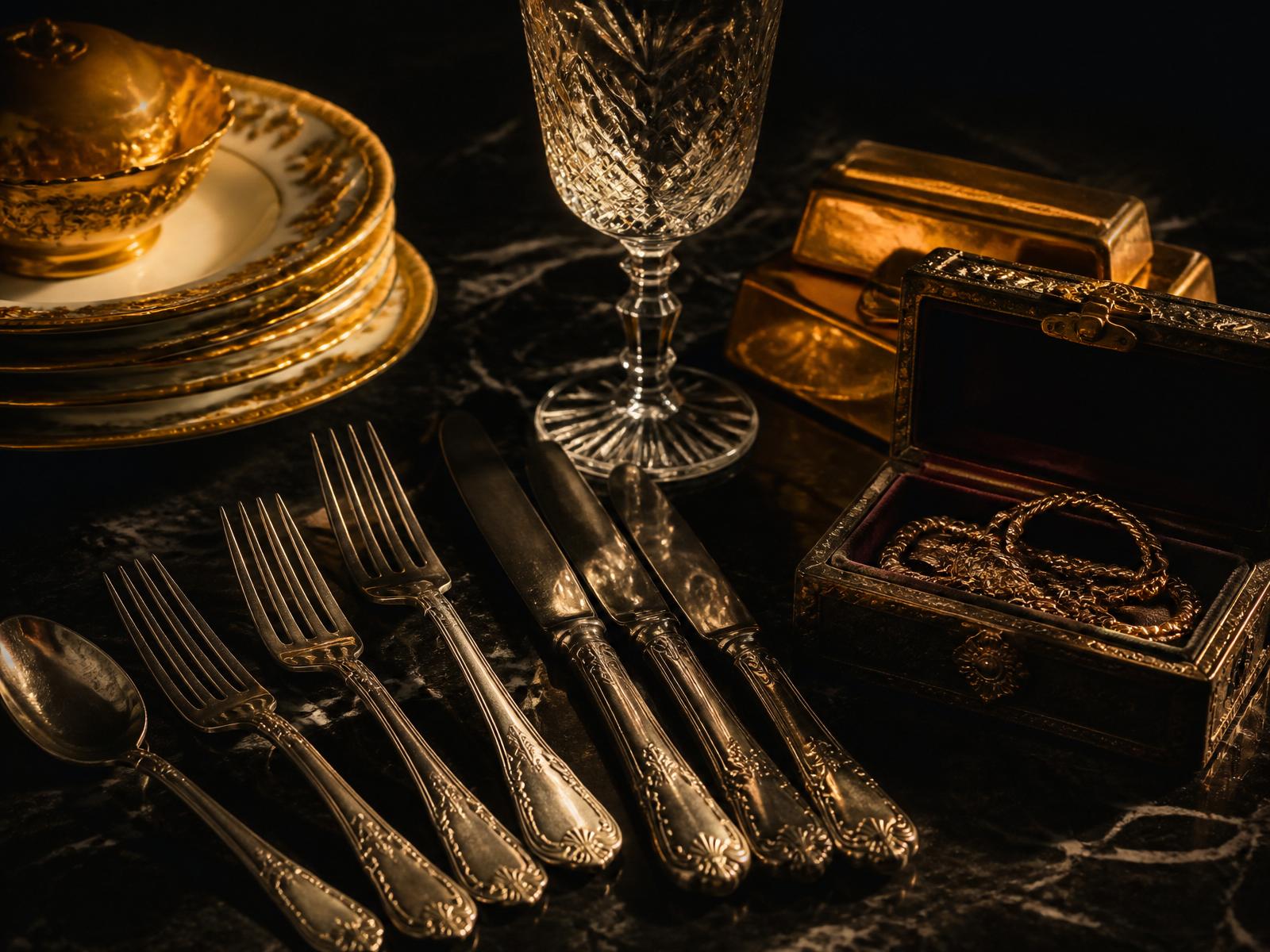
Sterling silver, cut crystal and fine porcelain alongside gold, art and watches: what to buy, what to avoid and who the reference houses are.
This editorial guide gathers verifiable information about sterling silver, cut crystal and signed porcelain as heirloom household goods: which historic manufactures remain present on the secondary market, which elements allow authentication and the difference between an asking price, an auction estimate and a realised sale price.
The content is informational. It does not constitute financial advice, offers no return projections, and does not guarantee appreciation, value retention or economic comparisons with other assets.
Sterling silver 925 contains 92.5% pure silver, verifiable by hallmark. Metal content is an auditable reference value — distinct from retail price, auction estimate and the price actually realised on the secondary market. Mesa Real does not guarantee that any piece will retain, exceed or match its material value in a future transaction.
Series made with craft processes are produced in small runs; the specific process is stated in each reference's manufacturer data sheet. When a manufacture retires a pattern, that does not automatically imply price appreciation: any variation depends on current demand, condition and documented provenance.
Christie's, Sotheby's, Bonhams and Bukowskis publish tableware auction results. Estimates (low/high) and asking prices can differ substantially from the realised price (hammer + buyer's premium). Always consult verifiable results before assuming any reference value.
A noble-table piece is a tangible household object and family heirloom. It is not a financial product, offers no contractual yield and its liquidity is not comparable to a listed asset. Any decision with economic expectations should be discussed with an independent adviser.
Puiforcat, Christofle, Odiot, Ercuis (France); Georg Jensen (Denmark); Buccellati (Italy); Asprey, Garrard (UK); Tiffany & Co., Gorham (USA).
Baccarat, Saint-Louis, Lalique, Daum (France); Moser (Bohemia); Waterford (Ireland); Val Saint Lambert (Belgium); Riedel Sommeliers limited editions.
Meissen, KPM Berlin, Nymphenburg, Fürstenberg (Germany); Sèvres, Bernardaud, Haviland (France); Herend (Hungary); Royal Copenhagen (Denmark); Ginori 1735 (Italy).
Rule of thumb: if the manufacture has more than 150 years of continuous operation and a living pattern archive, its antique pieces keep a market.
Every silver piece must carry its purity mark (925, French 950 Minerve, English Lion Passant) and the master silversmith's mark. On porcelain, look for the base mark, painter's number and mould date. These are verifiable; without them no reliable valuation is possible.
Original invoice, manufacture catalogue, auction certificate or aristocratic inventory improve traceability and secondary-market liquidity. The exact impact on price varies by piece and cannot be expressed as a universal percentage.
A cutlery service for 12 in its original chest, with all serving pieces, is generally easier to sell than the equivalent loose pieces. The price difference depends on the pattern, maker and demand at each auction.
Aggressive re-polishing can damage hallmarks and affect valuation. Undeclared repairs and rim chips reduce price to a variable extent depending on the appraiser. Prefer honest patina and transparent condition reporting.
Daily-use object, transmissible by inheritance, verifiable by hallmark and documentation.
Not a financial product: no contractual yield, limited liquidity and market-dependent price.
Complete services in their original chest tend to see a more active secondary market.
Demand depends on pattern, maker and the specific auction; no multiplier can be guaranteed.
Historic manufactures with an active archive and documented hallmarks make appraisal easier.
Attribution without signature or papers reduces certainty and resale prospects.
Buying silver-plate expecting the same market behaviour as solid silver: they are different products in content and in how auction houses treat them.
Discarding the original chest, box or certificate: without a paper trail the piece loses evidentiary value on the secondary market.
Re-polishing silver: can damage hallmarks and patina, both essential to appraisal.
Confusing antique Meissen with Thuringian copies: always verify the crossed swords and painter number with a specialist.
Buying at flea markets without an invoice: without a paper trail there is no resale documentation.
Assuming that an asking price or an estimate equals the price actually realised at auction: they are different figures.
The best test for a piece meant as a store of value remains the oldest one: would you set it on your Sunday table, and would you like your grandchildren to recognise it as theirs? If the answer is yes and the hallmarks confirm it, you have bought well.
We use strictly necessary cookies to operate the site and, with your permission, preference, analytics and marketing cookies to improve your experience. You may accept, reject or configure your preferences at any time. Cookie policy.