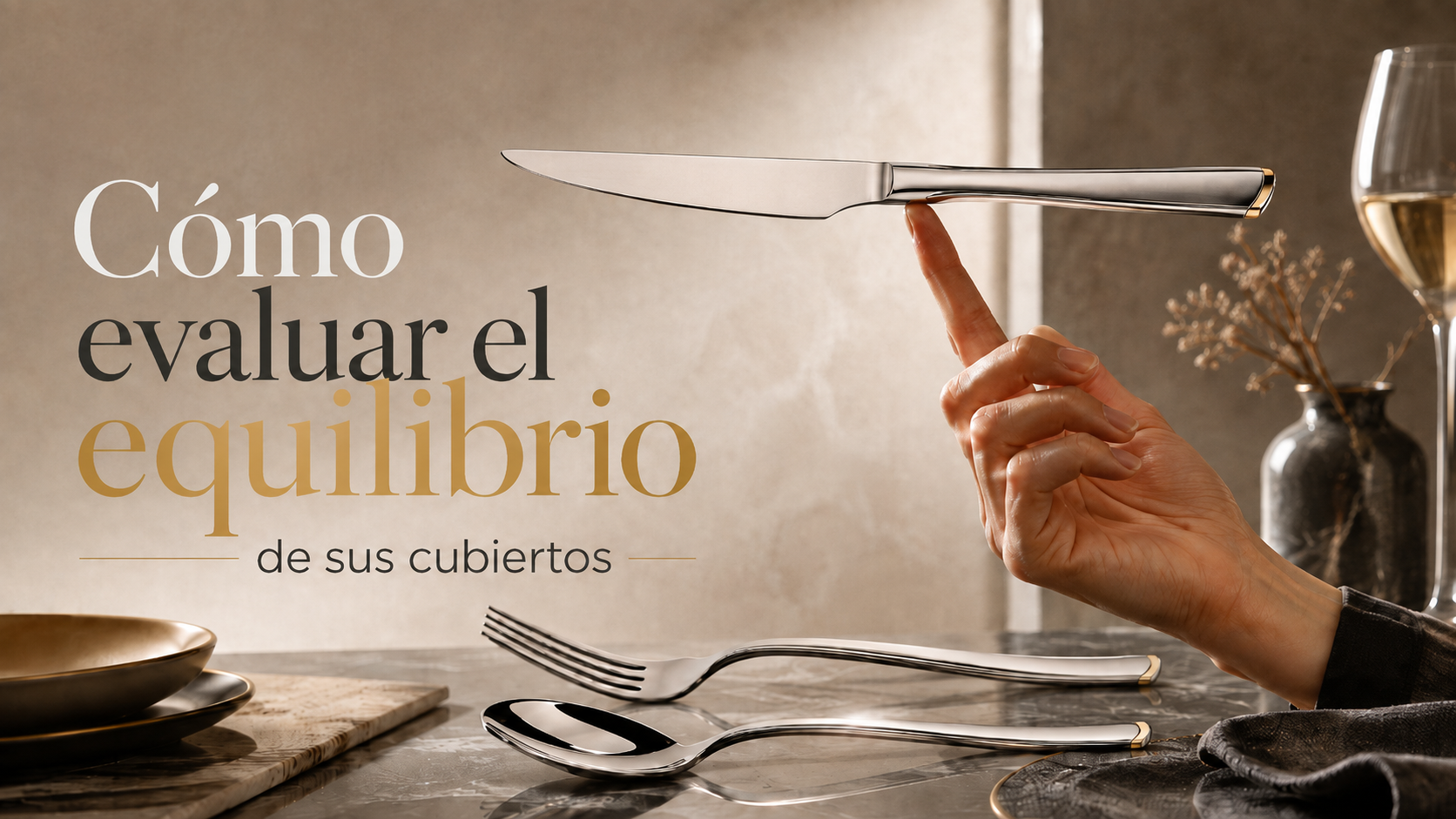
How to evaluate the balance of your flatware
A knife can be heavy and yet feel clumsy. A light spoon can offer impeccable control. The difference lies not only in the grams, but in how they are distributed between the handle and the functional part.
How to tell if a piece of flatware is well-balanced?
A piece of flatware is well-balanced when it can be held and moved with moderate pressure, without the head, the blade, or the end of the handle forcing continuous wrist correction. There is no universal point that works for all designs: the knife, fork, and spoon perform different movements. The most reliable test consists of holding each piece as it would be used at the table, slightly relaxing the fingers, and simulating cutting, piercing, or the movement of scooping food. Before purchasing a complete set, it is advisable to compare samples and explore the Mesa Real flatware selection.
The first impression is often deceiving. In front of a display case or a photograph, thick and heavy flatware may automatically seem superior. However, during a meal, it is not used as a stationary object: it is turned, tilted, rested, cuts, pierces, scoops, and is brought to the mouth dozens of times. Therefore, the true criterion is not how much it weighs, but how much effort it requires to control it.
Flatware designers work with the relationship between mass, length, handle section, transition toward the neck, and the shape of the functional part. The British house Robert Welch even offers sample sets to assess weight, size, and balance before acquiring a complete flatware set. Cutipol, for its part, describes the ergonomics of Goa as the result of the balance between resin and steel. Both examples show an essential idea: the final sensation arises from the whole, not from a single material or number.
What flatware balance really means
Balance is the way weight is distributed on both sides of the point from which you control the piece. The center of mass can be approximately located by resting the flatware on a finger, but that test only describes where the grams are compensated. It does not determine on its own whether the utensil will be comfortable when eating.
The reason is simple: the hand does not hold a knife, a fork, and a spoon in the same place or with the same movement. The knife needs to transmit pressure toward the blade. The fork must maintain orientation and precision when piercing or scooping. The spoon must keep the bowl relatively level while moving. Therefore, each piece deserves a distinct functional test.
Important distinction
Weight and balance are not synonyms. Weight indicates how much mass the piece has. Balance explains where that mass is located and how it influences use. Two spoons with the same weight can feel completely different if one concentrates the mass in the bowl and the other at the end of the handle.
| Piece | Main movement | Sign of good balance | Warning sign |
|---|---|---|---|
| Dinner knife | Pressing and moving forward over food | The blade is guided precisely without squeezing the handle excessively | The handle pulls backward or the blade rotates sideways |
| Fork | Piercing, lifting, turning, and stabilizing | The tines maintain their orientation with a relaxed grip | The head drops, rotates, or requires closing the fingers too tightly |
| Spoon | Scooping and transporting food | The bowl remains stable during the journey to the mouth | The head tips over or the handle forces the wrist to lift |
The 60-second test before buying

This sequence allows you to detect most problems without instruments. Ideally, you should test a main service piece—dinner knife, fork, and spoon—and not limit yourself to a teaspoon, as proportions can change within the same collection.
- Hold the piece as you would when eating. Do not hold it by the center to find the balance point first. Use your usual grip and observe if the handle fills the hand or creates pressure on an edge.
- Slightly relax your fingers. You should not drop the flatware. Reduce the force until you perceive which end it tries to fall toward. A slight tendency can be normal; constant correction is fatiguing.
- Simulate the actual gesture. Cut on a permitted surface, pierce a test food, or imitate the movement of a full spoon. Balance must be evaluated in motion.
- Change the angle. Rotate your wrist, lift the piece, and set it down again. Handles that are too flat, angular, or narrow may feel correct for five seconds and uncomfortable afterward.
- Compare, don't guess. Test at least two designs consecutively. The difference between the two is usually more evident than an isolated evaluation.
The practice of comparing samples is supported by the industry itself. Robert Welch states that the best way to choose flatware is to try it, and they market three-piece sets specifically to evaluate size, weight, and balance at home. It is not necessary for all brands to offer this service: you can also buy a single place setting, request individual pieces, or confirm the return policy before ordering a large set.
How to evaluate the balance of a dinner knife
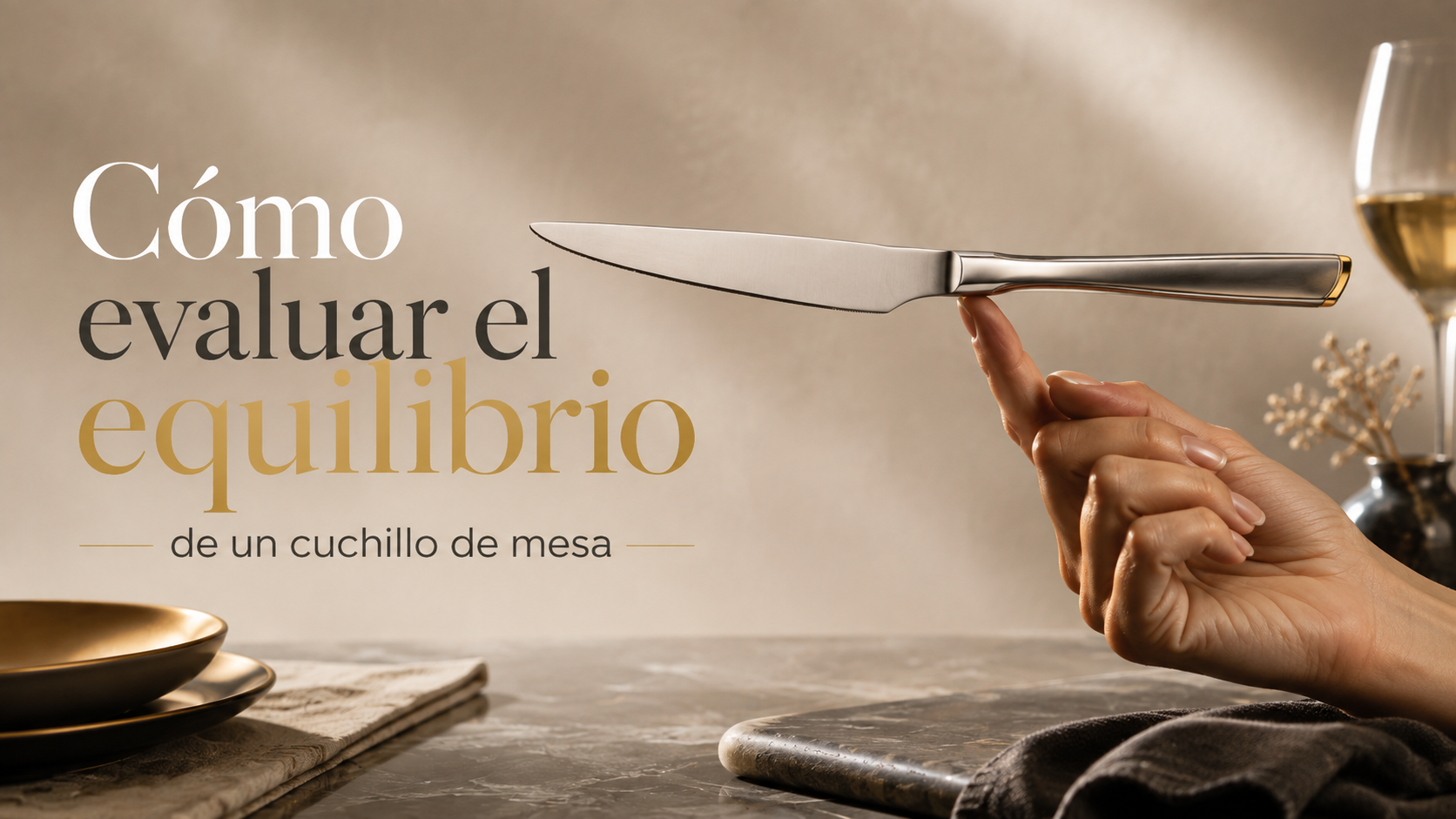
The knife is usually the most difficult piece to balance because it combines a functional blade with a handle that can be solid, hollow, monobloc, or made of another material. Its center of mass does not necessarily have to coincide with that of the fork and spoon. Nor is it a defect if the handle has more presence: it can help convey control, as long as it does not lift the blade or fatigue the hand.
Cutting and direction test
Hold the knife naturally and perform a short forward and backward motion. The blade should follow the chosen direction without wobbling. If the handle is too heavy for the blade's geometry, you will tend to compensate by pushing down. If the front part dominates, the tip may feel impatient and require more tension in the index finger.
Torsion test
Simulate cutting a food item that offers moderate resistance. The knife should not attempt to rotate within the hand. Especially check the transition between handle and blade, the lateral thickness, the edges, and any relief. A visually thin design can be excellent if it distributes its mass well; a bulky one can be uncomfortable if it concentrates weight far from the control point.
Caution
Do not check balance by resting the edge on your finger. Use the spine, the bolster, or a safe area of the handle. In a store, ask before performing a cutting test and use only the authorized surface.
How to evaluate the balance of a fork
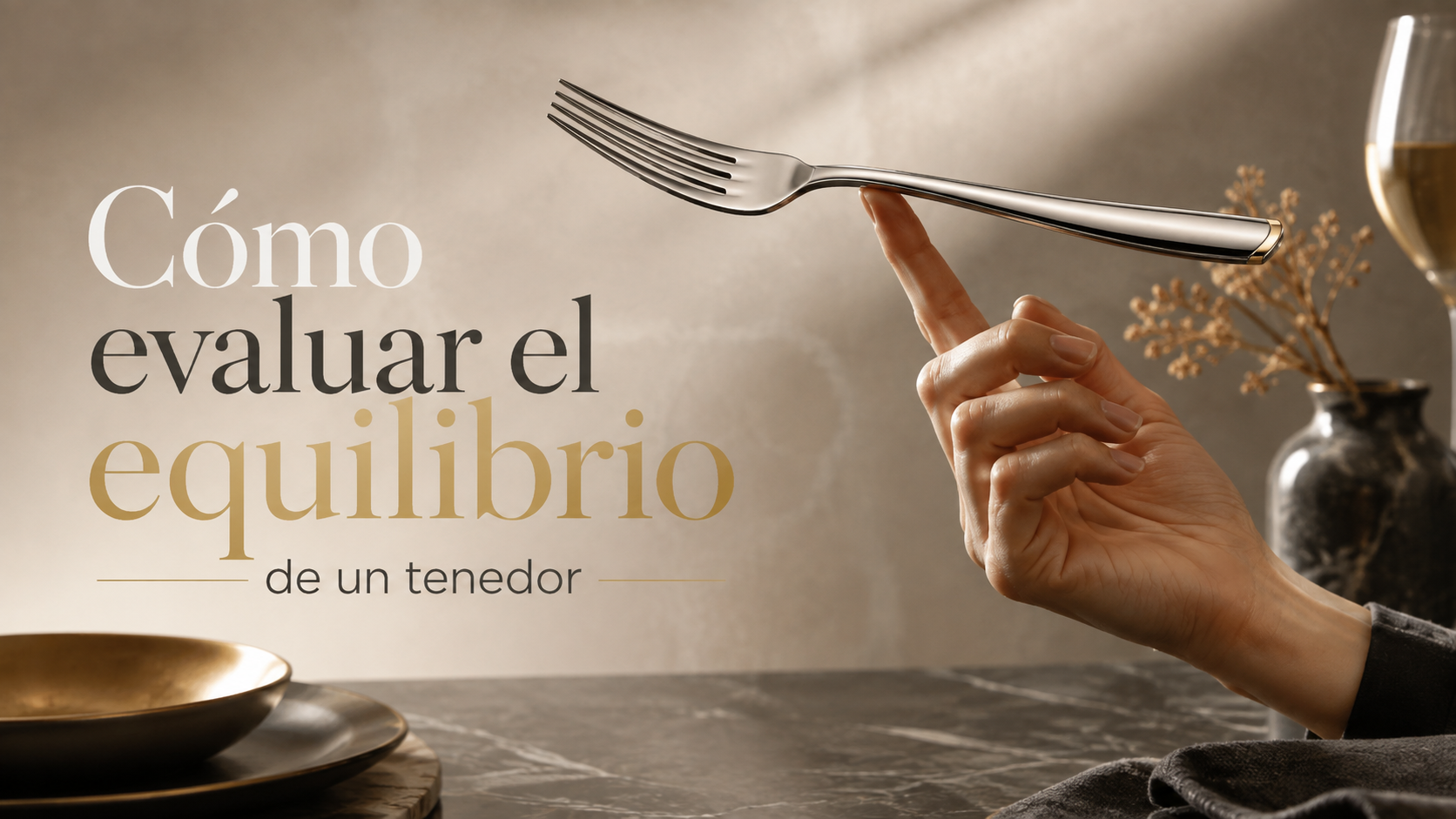
In a fork, lateral stability is as important as the relationship between the head and the handle. A wide head, long tines, or a very thin neck can shift the feel forward. The result is not always negative: some people prefer a clear presence in the functional part. The problem arises when the utensil rotates or forces you to grip it too tightly.
Tines-down test
Adopt the position used for holding or cutting food. Relax your thumb and observe if the fork maintains its orientation. Then, press gently on an appropriate surface. The force should travel toward the tines without the handle digging into your palm.
Rotation test
Perform the motion of twirling pasta. A balanced fork rotates continuously and stops with precision. If the end of the handle is excessively heavy or its cross-section is too flat, the movement may feel sluggish. If the head dominates, you may lose control when lifting the food.
How to evaluate the balance of a spoon
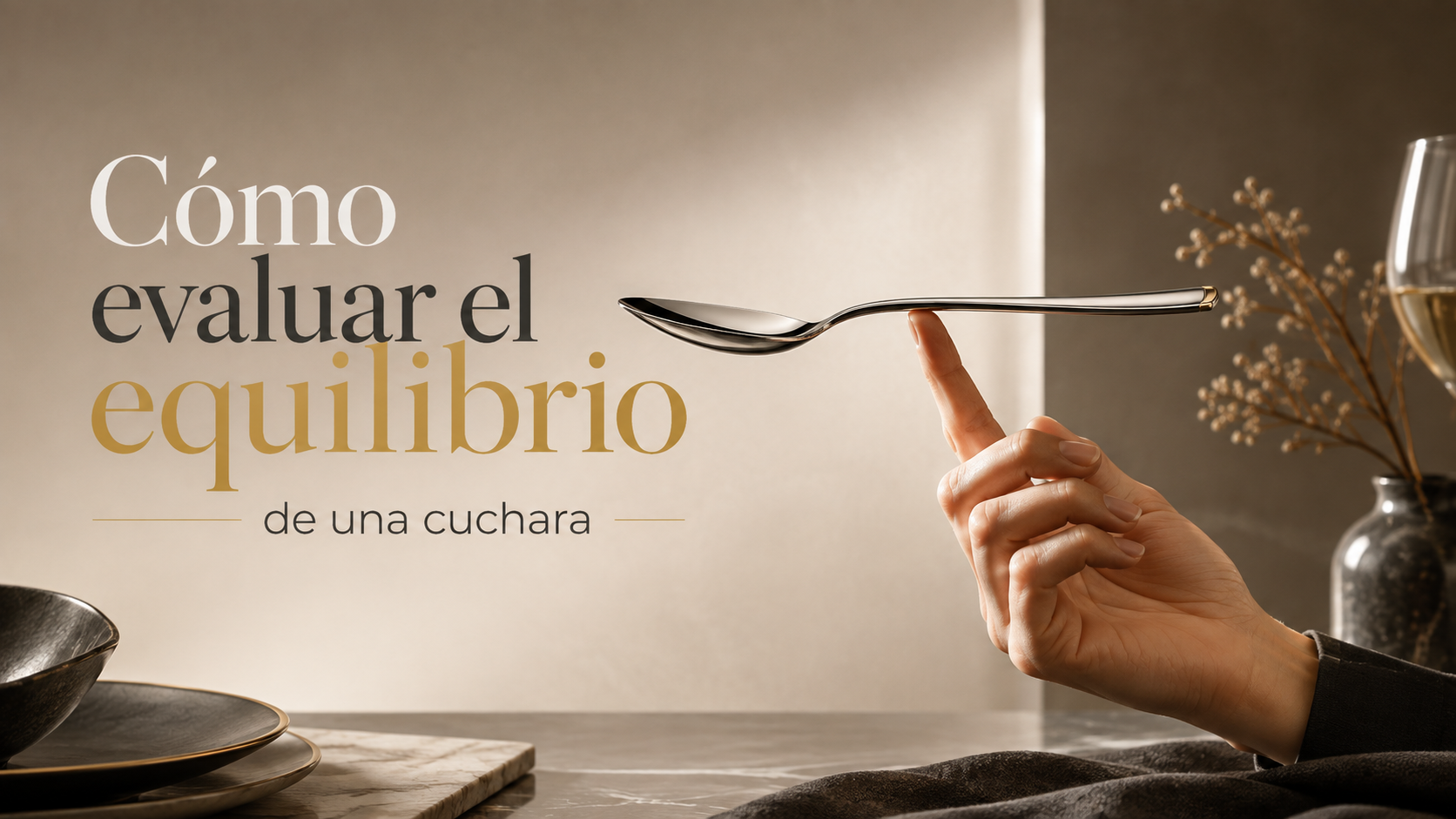
The spoon must carry food without requiring the wrist to constantly correct the tilt of the bowl. Weight plays a role here, but so do the depth, width, and curvature of the bowl. A spoon can be well-balanced and still not suit you because the bowl is too large for your eating style.
Level test
Imagine the spoon contains broth. Move it from the plate toward your mouth using the most relaxed grip that remains secure. The bowl should stay stable. When the head drops markedly, the fingers must work harder to avoid spills. When the handle dominates, the wrist tends to rise and the front edge may dip.
Edge and transition test
Run your thumb over the grip area and observe the transition toward the neck. The edges should feel finished and smooth. The quality of the balance loses value if the piece presses against a joint or features uncomfortable sharp edges. Award-winning designs like Balsa, recognized by Red Dot, combine mass distribution, smooth radii, and formal decisions oriented toward comfort; it is a fine example of how ergonomics and aesthetics can be resolved together.
Should the balance of the three pieces match?
No. A good collection should feel coherent, but not identical. The knife needs authority to cut; the fork, precision; the spoon, horizontal stability. Forcing the same balance point on all pieces could compromise one of those functions.
Coherence is recognized in other aspects: handle thickness, smoothness of the edges, scale, temperature to the touch, formal language, and level of effort. When you alternate between knife, fork, and spoon, no piece should feel foreign to the collection nor force you to completely modify your grip.
Balance also changes the perception of the table
The experience is not only mechanical. Research published by specialists linked to the University of Oxford shows that the weight, shape, size, and other properties of flatware can modify certain assessments of food. Another study in a real gastronomic setting found that heavier flatware perceived as higher quality influenced enjoyment and the stated willingness to pay.
These results do not mean that the heaviest flatware is always better or that it produces the same effect on every table. They do demonstrate that flatware is part of the sensory experience. Balance adds something different than weight: it allows that presence to be perceived without turning every gesture into an effort.
Purchase decision
For daily use, prioritize a neutral feel, smooth edges, and control with little pressure. For a formal table, you can choose a greater presence, provided the piece does not become fatiguing. In professional gastronomy, add service speed, consistency between units, cutting capacity, and per-piece replacement. Our guide for restaurants and hotels expands on these operational criteria.
How to evaluate balance when shopping online
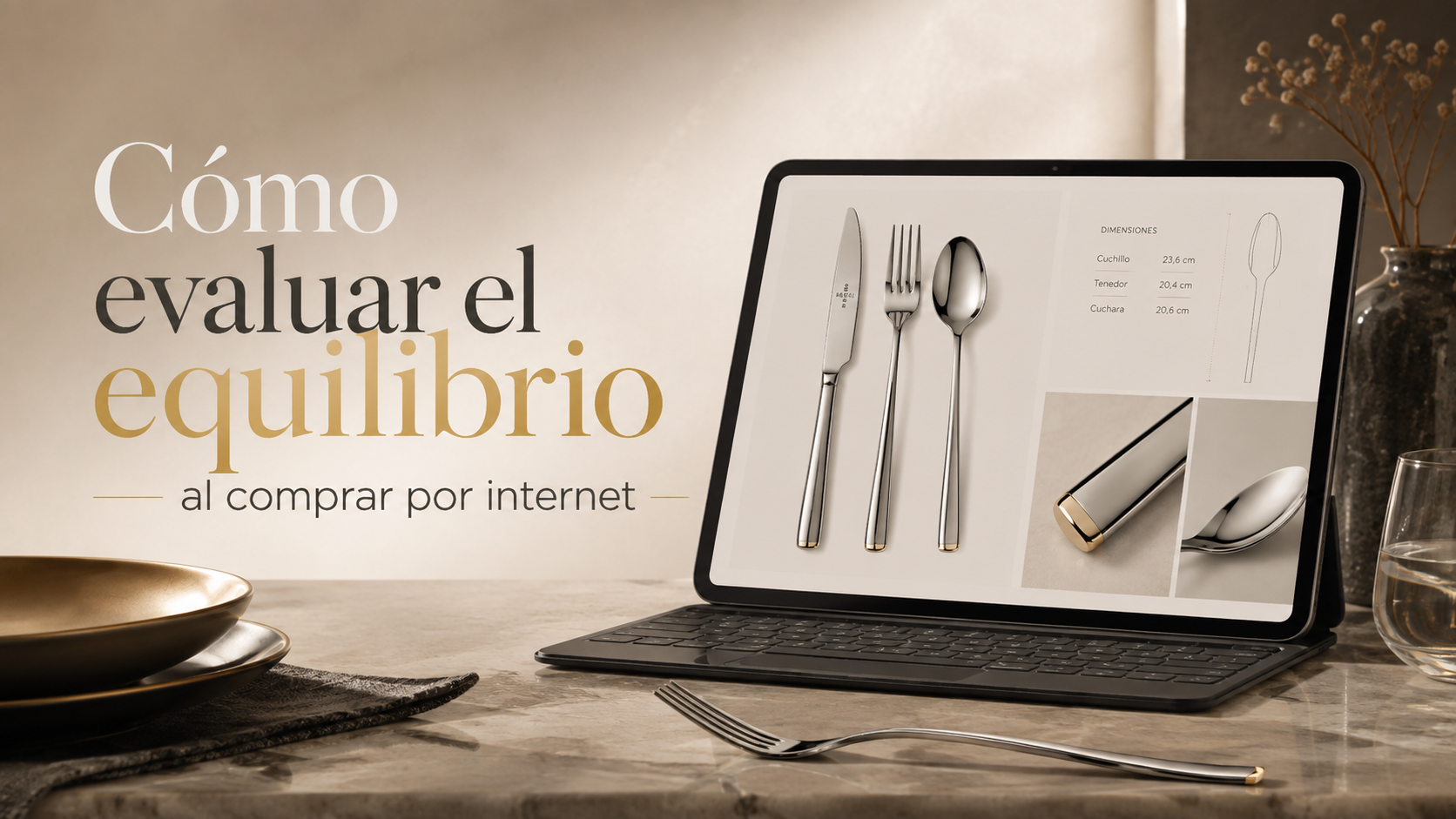
A front-facing photograph does not allow you to judge balance. When you cannot test the collection in person, turn the purchase into a verification process. The most useful information is not the total weight of the set, but the measurements and weight of each piece, the knife construction, the handle cross-section, and the possibility of purchasing a sample.
- Request the individual weight of the dinner knife, fork, and spoon.
- Ask for the total length and, whenever possible, a photograph of the side profile and the underside.
- Confirm if the knife is monobloc, hollow-handle, or has an inserted blade.
- Ask if the manufacturer sells an individual place setting or a sample set.
- Check if open-stock pieces are available for replacement and expansion.
- Look for comments on comfort, control, and size, not just appearance or a "heavy feel."
- Check the return policy before purchasing a flatware set for twelve.
It is also advisable to compare the design with your dinnerware. Place a sample next to your plates and glasses: the length, luster, handle scale, and visual volume can transform the composition. In the guide The Art of Entertaining, you will find the formal arrangement of knives, forks, and dessert pieces.
Two real references to observe before deciding
The following catalog sheets allow you to compare two compositions from the same collection. They serve to review proportions, set contents, and formal language. The definitive evaluation of balance requires a physical sample or additional technical information; a photograph is no substitute for the in-hand test.
Villeroy & Boch · Afina
Afina flatware set, 24 pieces
Compact format to compare the essential pieces of the collection. Consult the product sheet for composition, availability, and current terms.
Villeroy & Boch · Afina
Afina flatware set, 30 pieces
A more extensive composition of the same line, useful for contrasting the number of pieces and service needs before making a purchase.
You can also explore the available stainless steel flatware, consult the houses present at Mesa Real, or review the collections with replacement guarantees. The availability of individual pieces matters because even the best-balanced flatware loses part of its practical value if it cannot be replaced later.
Final checklist to verify balance
- I have tested the table knife, fork, and spoon, not just a small piece.
- I distinguish total weight from weight distribution.
- I can relax my hand without the piece rotating or falling sharply.
- The knife directs the blade without forcing me to apply excessive pressure.
- The fork maintains its orientation when piercing, lifting, and turning.
- The spoon keeps the bowl stable throughout the movement.
- Edges, reliefs, and transitions do not create pressure points.
- The size corresponds to my hand, my plates, and my way of eating.
- I have compared at least two designs.
- I know the knife's construction and the material of each piece.
- Samples, returns, or single place setting purchases are available before the full order.
- The collection allows for replacements and expansion.
The best sign is that the flatware disappears during the meal
Good balance does not need to call attention to itself. It is recognized when the utensil responds, the hand remains relaxed, and the gesture feels natural. The design can be light or substantial, classic or contemporary, but it should not force you to fight against the head, the blade, or the handle.
Before choosing based on shine, thickness, or prestige, test the relationship between the piece and your hand. That one-minute evaluation can prevent years of minor discomforts. To compare collections, visit our cutlery category or request a recommendation based on use, the style of your table, and the number of guests.
Mesa Real Advisory
Choose the collection for how it is used, not just how it looks
We can help you compare materials, construction, composition, replacement, and suitability for home use, gifts, hospitality, or catering.
Explore flatware Request consultation
Frequently asked questions
Where should the balance point of a piece of flatware be?
There is no universal position valid for all designs. The approximate point can be located by resting the piece on a finger in a safe area, although comfort depends on the grip and actual movement. The knife, fork, and spoon can have different centers of mass and still form a coherent collection.
Is a heavy piece of flatware better balanced?
Not necessarily. A heavy piece of flatware can concentrate too much mass at the end of the handle or in the functional part. A lighter one can offer greater control if it distributes the weight well. Perceived quality and balance are related to the experience, but they should not be confused.
How do I test a dinner knife without cutting myself?
Hold it by the handle and evaluate the movement over an authorized surface. To approximately locate the center of mass, rest the spine, the neck, or a safe area—never the edge—on your finger. In a store, request permission before performing any functional tests.
Does 18/10 steel guarantee good balance?
No. The 18/10 designation commercially describes the steel composition of certain pieces, but it does not define length, thickness, geometry, or mass distribution. A flatware set can use good steel and not fit your hand; you must also evaluate design, finish, construction, and comfort.
What information should I ask for when buying flatware online?
Request the weight and length of each main piece, side-view images, handle cross-sections, knife construction, sample availability, open-stock availability, return policy, and replacement availability. Avoid deciding solely based on the total set weight or front-facing photographs.
Is it advisable to buy a single place setting first?
Yes, especially when the investment is significant or the design has unusual proportions. Testing a knife, a fork, and a spoon during several meals allows you to detect fatigue, inadequate sizing, uncomfortable edges, or a weight distribution that is not noticeable in a brief trial.
Sources and recommended reading
- University of Oxford Research Archive: The taste of cutlery: how weight, size, shape and colour affect food perception .
- Flavour: Cutlery matters: heavy cutlery enhances diners’ enjoyment in a realistic dining environment .
- Robert Welch Designs: Iona Bright Cutlery Sample Set .
- Cutipol: Goa — balance between resin and steel .
- Red Dot Design Award: Balsa — balance, ergonomics and ease of use .