
GUIDE · FLATWARE AND CONSERVATION
Storing silver does not mean hiding it in just any drawer. To delay tarnish for months, it is advisable to reduce four factors: sulfur gases, humidity, fingerprints, and friction. The most reliable strategy is to dry completely, wrap each piece separately, add an anti-tarnish barrier, and seal the set in a stable container. No domestic method guarantees indefinite shine, but a well-prepared microenvironment can notably decrease the need for polishing.
QUICK ANSWER
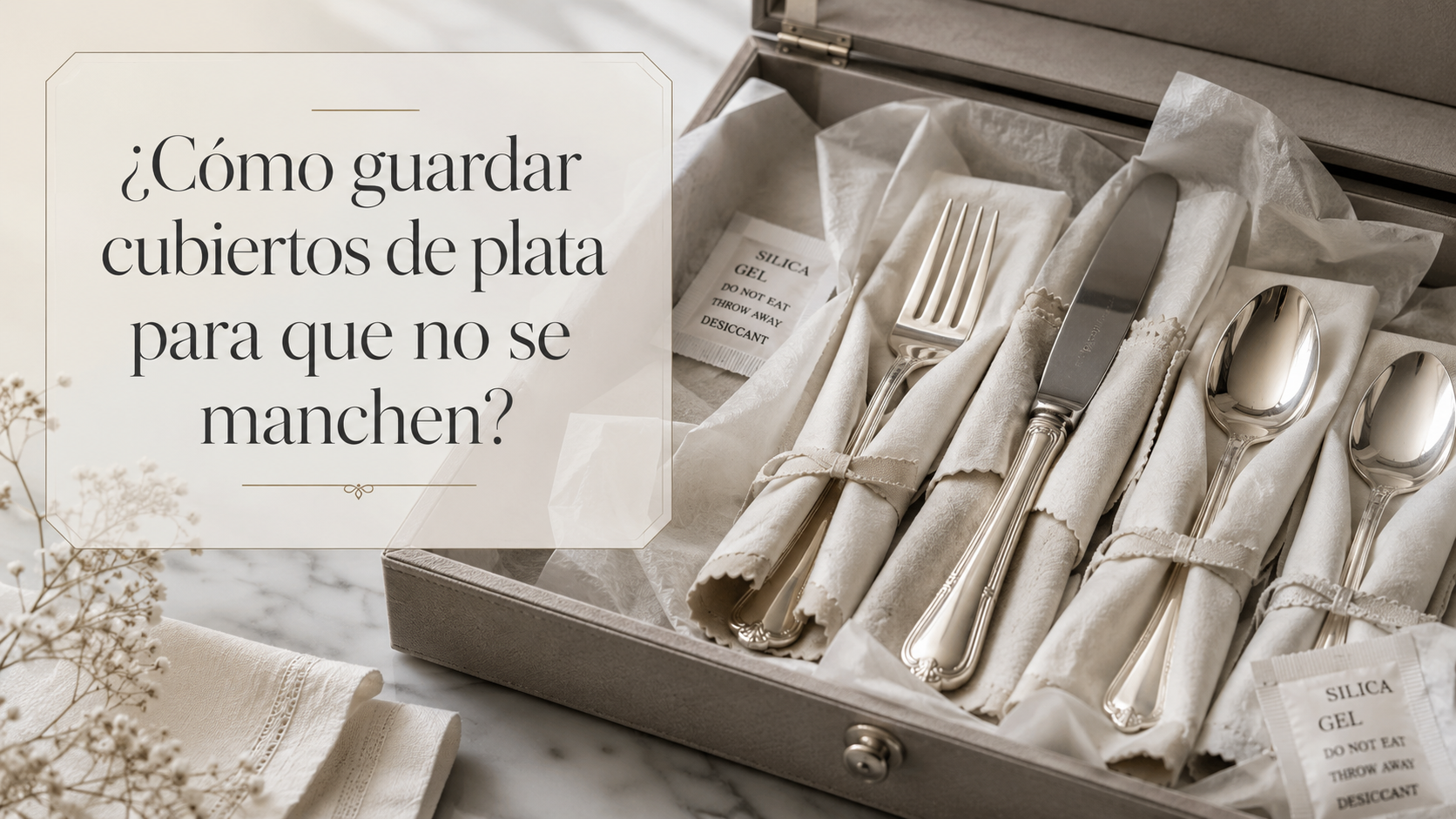
How to store silver flatware so it doesn't tarnish?
First, check if it is solid silver, 925 sterling silver, silver plate, or a composite piece. Leave it clean and completely dry; handle it with clean nitrile or cotton gloves; wrap each piece of flatware in acid-free, unbuffered, sulfur-free conservation tissue paper, or in a suitable anti-tarnish cloth; then place it in a stable, tightly sealed bag or box, preferably made of polyethylene or PET.[3] Inside, you can add conditioned silica gel to control humidity and a sulfur gas scavenger, always contained and without loose contact with the pieces.[1]
IN THIS ARTICLE
- Why silver tarnishes while stored
- The seven-step method
- Recommended materials and materials to avoid
- How to adapt the system to the type of flatware
- Errors that seem to protect silver
- When to review storage
- Checklist
- Frequently asked questions
Why silver can tarnish even when no one uses it
The dark layer that appears on silver is not simply dust. Tarnish forms when the surface reacts with sulfur-containing gases and produces, primarily, silver sulfide. In sterling silver, copper compounds from the alloy can also be involved. This is why flatware can change color inside a closed drawer: air, wood, certain papers, textiles, adhesives, or rubber can introduce reactive substances into a small space.[2]
Humidity does not create all the problems on its own, but it accelerates many reactions and promotes a less stable environment. Added to this are salts and oils from the hands, which are capable of leaving visible fingerprints. A freshly washed piece that retains water in a joint, an inserted blade, or a hollow handle can be exposed for weeks to a trapped source of moisture.
The practical consequence is important: prevention does not depend on a single miracle product. An airtight bag is useless if it is closed with wet flatware; an anti-tarnish cloth loses effectiveness if it is saturated or contaminated; silica gel controls humidity but does not replace a barrier against sulfur gases. The result comes from several layers of protection working together.
THE FOUR FACTORS
Reactive gases Sulfur compounds present in the air or emitted by unsuitable materials. Humidity Residual water, condensation, or a humid and unstable domestic environment. Contact Salts, oils, cosmetics, and dirt transferred by the hands. Friction Stacked pieces, rough papers, staples, rubber bands, or dust particles.
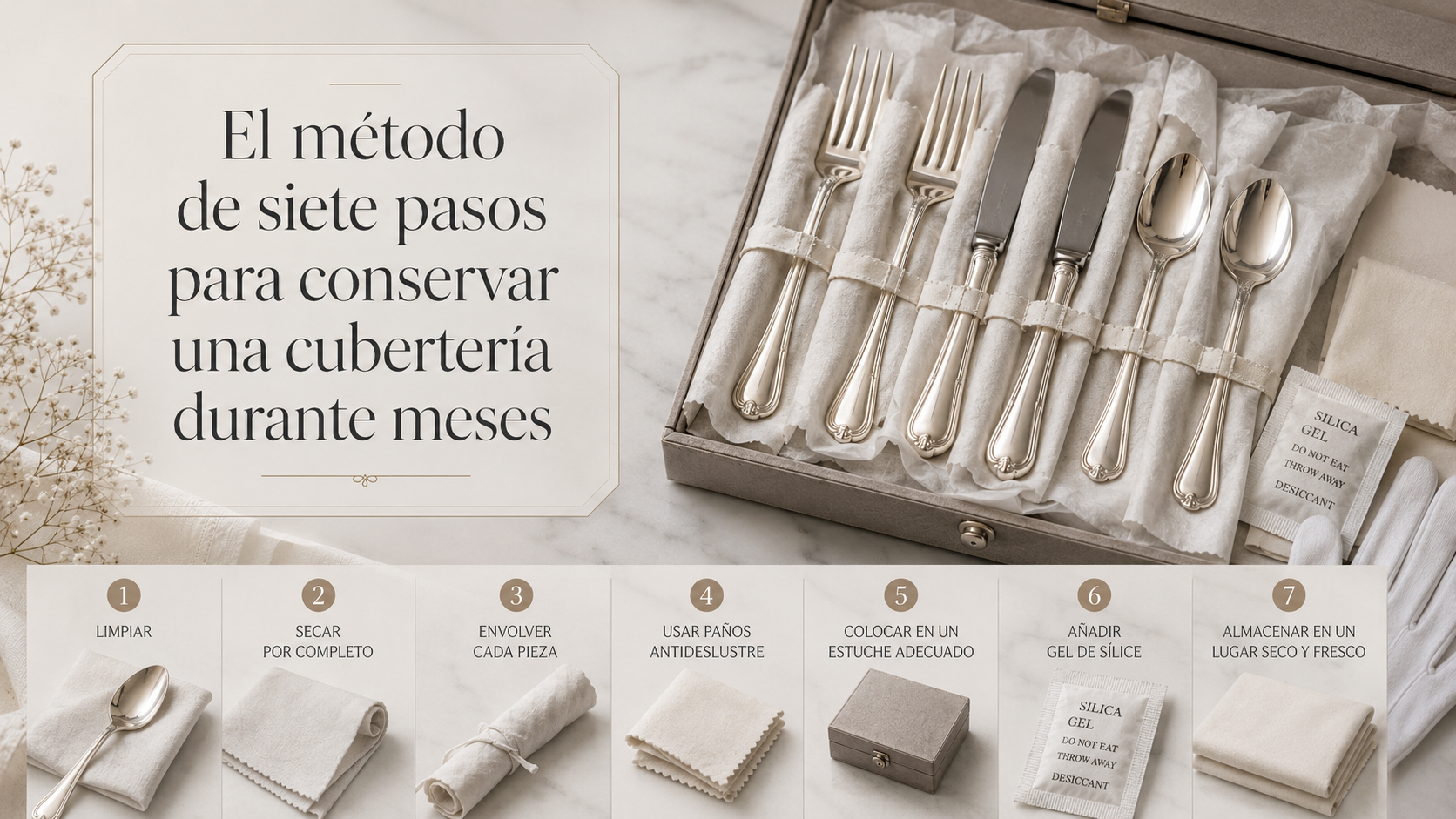
The seven-step method for preserving flatware for months
1. Identify the material before storing
Check hallmarks, marks, and documentation. “925,” “Sterling,” or equivalent indications usually identify sterling silver. Do not deduce the complete composition from an isolated figure: confirm the marking system, country, era, and manufacturer's documentation. An inserted steel blade, a hollow handle, a weighted piece, or an element made of wood, bone, mother-of-pearl, or other materials requires additional precautions.
Do not treat solid silver and a thin layer of silver plating the same way. Repeated polishing can wear down the coating until the base metal becomes visible. Before intervening on a family heirloom, photograph hallmarks, monograms, the case, and its condition. This documentation complements the Mesa Real guide on conservation, traceability, and value of tableware pieces.
2. Remove residue, but do not polish routinely
Flatware must be clean before going into storage. Food residue, detergent, dust, or polishing products can remain active inside a sealed bag. However, “clean” does not necessarily mean “freshly mirror-polished.” Conservation institutions warn that every removal of tarnish can remove a microscopic amount of silver; in silver-plated pieces, the risk is higher.[1]
If the piece only shows a uniform and stable patina, do not automatically polish it before storing. If cleaning is needed, follow the manufacturer's instructions or consult a silversmith or conservator, especially when there are decorations, gilding, niello, soldered joints, inserted blades, or organic materials. This guide focuses on preventive storage and does not replace a restoration diagnosis.
3. Dry every joint completely
Dry with a soft, clean, lint-free cloth. Observe the area where the blade meets the handle, reliefs, engravings, and cavities. Do not close the bag while perceptible moisture exists. In hollow-handle knives or composite pieces, immersion may be inappropriate because liquid can penetrate through tiny joints and become trapped.[1]
After drying, allow the pieces to reach room temperature in a clean place free of kitchen vapors. This step reduces the risk of trapping residual moisture or condensation.
4. Handle with clean gloves
Use powder-free nitrile gloves or clean, dry cotton gloves. Skin oils and salts can leave dark stains and fingerprints. Avoid latex gloves and rubber bands near silver, as certain rubber materials can contain or release problematic compounds. If gloves are not available, hold the flatware with a clean cloth and touch as little surface area as possible.[4]
5. Wrap each piece of flatware separately
Metal-to-metal contact causes scratches and allows dirt from one piece to transfer to another. Wrap each knife, fork, and spoon in archival-quality, acid-free, unbuffered, and sulfur-free tissue paper. The "acid-free" label alone does not always describe the entire product; for silver, the unbuffered specification is particularly relevant.
Another option is a washed cotton pouch of known composition, combined with an anti-tarnish cloth designed for silver. Do not use newspapers, decorative tissue paper, ordinary cardboard, wool, or felt of unknown composition. Also, do not tighten the wrapping with rubber bands, wire, or adhesive tape in contact with the metal.
6. Add a tarnish barrier
Anti-tarnish cloths and gas scavengers act as a sacrificial defense: they react with or adsorb contaminants before they reach the flatware. Some specialized fabrics incorporate silver particles or threads that darken first. They should be used according to the manufacturer's data sheet and replaced when they lose effectiveness or have been exposed for a long time.[4]
A sulfur gas scavenger or conservation-grade activated carbon can be added. Conditioned silica gel serves another purpose: it helps moderate humidity within the microenvironment. Keep both materials inside breathable envelopes or suitable containers, clearly labeled and without loose grains on the flatware. Do not rely solely on silica gel to stop tarnishing.
7. Create a stable microenvironment and store it in the right place
Place the wrapped pieces inside a stable self-sealing polyethylene bag or a tightly closed container made of compatible materials. PET can also be used in preservation systems when the format and sealing are appropriate. Gently expel excess air without compressing reliefs or deforming handles. Do not vacuum seal a delicate piece or seal flatware if moisture cannot be ruled out.
Store the set in an interior, dark, clean cabinet with a relatively stable temperature. Avoid proximity to sinks, dishwashers, ovens, bathrooms, walls with condensation, cleaning products, paints, wool, rubber, and unsealed wood. If using the original case, check its condition: its documentary value may justify keeping it, but it does not require leaving the silver in direct contact with a degraded lining. You can store the protected pieces inside the case or keep the case separately.
The most elegant preservation is not frequent polishing, but building an environment that makes correcting damage unnecessary. Mesa Real · House Editorial
Recommended materials and materials to avoid
| Element | Recommended Use | Caution or Alternative | Function |
|---|---|---|---|
| Conservation tissue paper | Acid-free, unbuffered, sulfur-free, and archival quality. | Avoid decorative paper, newspaper, and ordinary cardboard. | Separates pieces, reduces friction, and limits transfers from the environment. |
| Anti-tarnish silver cloth | Specific product, clean, and used according to instructions. | Do not substitute with felt, wool, or velvet of unknown composition. | Intercepts part of the gases that promote tarnishing. |
| Polyethylene bag or stable container | Tight seal, dry piece, and previously wrapped. | Do not use a dirty, perforated, odorous bag or one of uncertain composition. | Reduces continuous air exchange with the environment. |
| Conditioned silica gel | Inside a sachet or cartridge, without direct contact and with saturation control. | Do not insert loose grains or seal wet pieces expecting the gel to dry them. | Moderates the humidity of the microenvironment. |
| Sulfur scavenger or activated carbon | Product suitable for conservation, contained and replaceable. | Do not confuse its function with that of a desiccant. | Adsorbs gaseous pollutants that can darken silver. |
| Gloves | Powder-free nitrile or clean, dry cotton. | Avoid latex, rubber, and reused gloves with residue. | Reduces fingerprints, salts, and oils on the surface. |
| Original case | Preserve for its historical and documentary value, with an internal barrier if necessary. | Do not rest silver on crumbling, sticky, damp, or odorous linings. | Protects provenance, but does not always create a safe microenvironment. |
How to adapt the system to the type of flatware
925 Sterling Silver
925 silver contains 92.5% silver and a remaining proportion of other metals, usually copper. It can tarnish and should not be stored as if it were chemically inert. The method of individual wrapping, anti-tarnish barriers, and closed containers is appropriate as long as the piece is dry and does not include incompatible components. To explore references whose material is declared by the manufacturer, the Mesa Real flatware selection keeps commercial information separate from this editorial guide. For navigation access, you may also consult the filter for pieces declared as 925 silver; the product sheet for each reference must prevail over the filter name.
Silver-plated flatware
The priority is to preserve the surface layer. Avoid frequent polishing, intense pressure, and multi-purpose products. A localized spot does not justify treating the entire piece aggressively. If the base metal appears on edges or reliefs, consult a specialist before attempting to match the color. Preventive storage offers a special benefit because it reduces the repetition of polishing cycles that can thin the silver plating.
Hollow-handle knives and composite pieces
A steel blade, a filled handle, or an organic ornament changes the treatment. Do not submerge by default and do not apply chemicals without knowing the construction. Carefully dry the joint and store the piece so that it does not bear weight. When there is mobility, cracks, the sound of loose parts, or leakage, suspend wet cleaning and request a professional evaluation.
Antique, signed, or heirloom flatware
Maintain an inventory with photographs, measurements, hallmarks, number of pieces, missing items, and the condition of the case. Do not use adhesive tapes on historical labels or mark the metal. For pieces with potential heritage relevance, maximum shine is not always the goal; a stable patina and a non-repolished surface may be preferable. The guide on the noble table as a tangible asset explains why hallmarks, documentation, and declared restorations matter for traceability.
Seven errors that seem to protect silver, but can make it worse
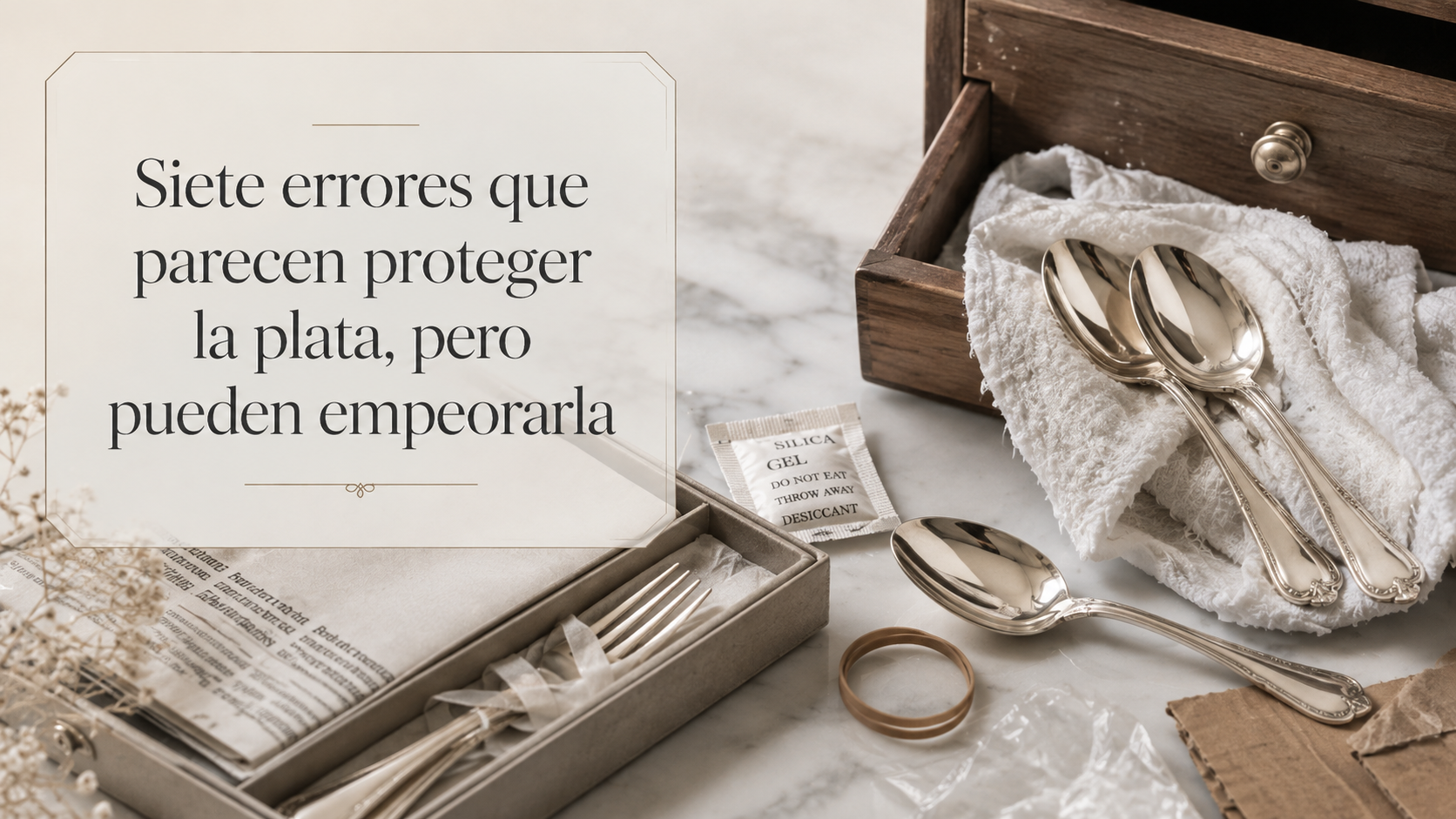
- Storing everything together in a drawer. Pieces get scratched, fingerprints are transferred, and the air in the furniture continues to circulate.
- Polishing before every storage. Immediate shine can come at the cost of unnecessary material removal.
- Closing the bag with moisture inside. An airtight barrier can also lock the problem in.
- Using only silica gel. The desiccant helps with humidity, but it is not a substitute for a gas scavenger or a compatible wrap.
- Trusting any dark cloth. The color does not prove it is an anti-tarnish fabric or that it is sulfur-free.
- Tying bundles with rubber bands. Rubber can deteriorate, stick, and introduce reactive substances.
- Applying electrochemical remedies without a diagnosis. Methods involving aluminum and alkaline solutions can leave a matte surface, affect finishes, or be unsuitable for hollow, composite, or silver-plated pieces.[1]
The Mesa Real editorial rule is simple: when a preservation method cannot be explained without omitting relevant risks, it should not be presented as a universal hack.
When to inspect stored flatware
There is no universal timeframe that guarantees months without spots. The result depends on environmental pollution, humidity, the seal, the materials, the initial condition, and how often the container is opened. Inspect the system periodically and also after a move, a very humid season, a leak, renovations, painting, or changes in the cabinet.
During the inspection, do not disassemble everything unnecessarily. Observe the seal, the presence of condensation, odors, new spots, silica gel packets with indicators, and the condition of the anti-tarnish material. If one piece darkens while the others remain stable, investigate its composition, residues, or specific contact instead of polishing the entire set.
Record the date and take a photograph. This practice allows you to know if the system actually works in your home and avoids relying on memory. For an extensive collection, use discreet codes on the pouches—never adhesives on the metal—and a digital list with location and status.
BEFORE CLOSING THE CONTAINER
Ten-point checklist
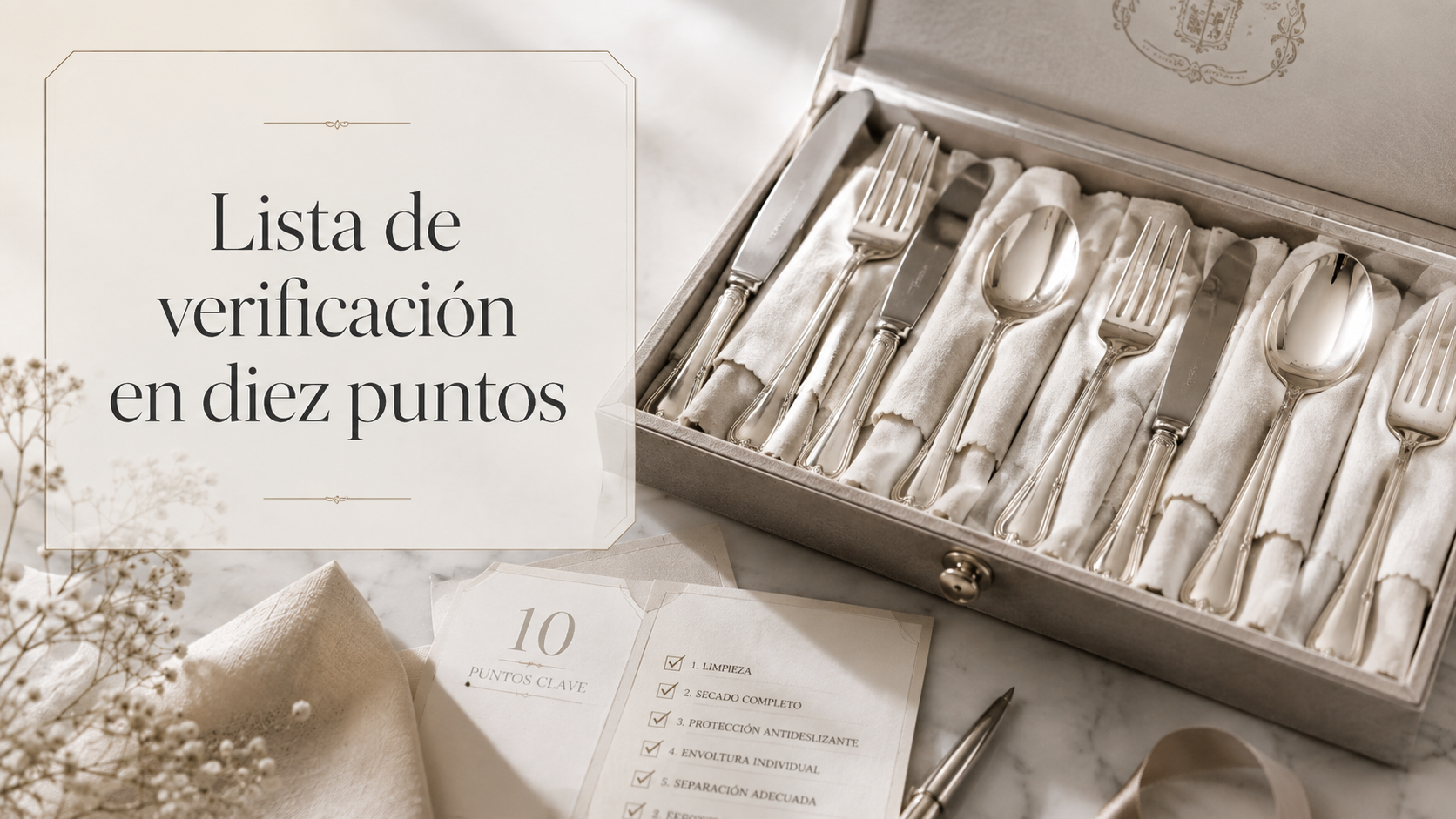
- Material, hallmarks, and components identified.
- Food particles, dust, and product residues removed.
- Piece completely dry, including joints and reliefs.
- Final handling with powder-free nitrile or clean cotton.
- Each flatware piece wrapped separately.
- Paper or fabric declared suitable for silver conservation.
- No rubber, wool, newspaper, common cardboard, or adhesives in contact.
- Desiccant and gas scavengers contained, labeled, and replaceable.
- Bag or box stable, clean, intact, and properly closed.
- Indoor location, dark, clean, and away from humidity and chemicals.
Preserving does not mean turning flatware into an untouchable piece
Good preservation allows you to use silver with greater peace of mind. Before a dinner, remove the pieces using gloves or a clean cloth, inspect them, and prepare only those that are necessary. After service, follow the instructions corresponding to their material and construction, dry them completely, and restore the microenvironment. In the guide The Art of Entertaining with Distinction, you will find the flatware arrangement according to the menu sequence.
When choosing new flatware, do not buy based on appearance alone. Confirm the exact material, the type of knife, the possibility of replacements, care instructions, and packaging. The houses selected by Mesa Real page and the flatware category are the appropriate destinations for commercial intent; this article maintains its informative and preventive function.
Frequently asked questions about storing silver flatware
Can a common self-sealing bag be used?
A clean polyethylene bag can reduce air exchange if the piece is dry and previously wrapped in a compatible material. Do not place bare metal against a rough or contaminated bag, do not use PVC of unknown composition, and do not assume that any plastic will remain stable for years.
Does silica gel prevent silver from tarnishing?
Not on its own. It helps control humidity within an enclosed space, while tarnish is primarily related to sulfur-containing gases. For more complete protection, combine a conditioned desiccant with appropriate wrapping and a gas scavenger or anti-tarnish cloth.
Should flatware be polished before storage?
Only when necessary and using a method appropriate for the piece. Repeatedly removing tarnish removes material; on silver plate, it can wear down the silver layer. For storage, cleaning residues and thorough drying are priorities. A stable patina does not always require immediate intervention.
Can flatware be kept in its wooden chest?
Yes, if the chest is dry, clean, and in good condition, but it is advisable to create a barrier between the silver and potentially reactive materials. Store each piece wrapped and, whenever possible, inside a compatible bag or sleeve. Preserve the chest for its documentary value even if the original lining is no longer suitable for direct contact.
Does anti-tarnish cloth last forever?
No. Its capacity is limited and depends on exposure and the specific product. Review the manufacturer's instructions, physical condition, odor, and any color changes. Replace the material when it is deteriorated, contaminated, or when the system stops controlling tarnish as effectively as before.
What to do if the silver is already black?
Do not apply a universal remedy without first identifying the material, the silver plating, any gilding, decorations, and construction. An antique, hollow, composite, or heavily silver-plated piece can be damaged by immersion, chemical baths, or abrasives. Seek professional advice when there is historical value, significant wear, or doubts about the surface.
Can knives and forks be stored in the same package?
They can remain in the same outer container, but each piece must be separated. Especially protect edges, tips, and joints. Do not place heavy knives on top of spoons or forks, and avoid pressure that could deform thin pieces or mark hollow handles.
EDITORIAL AND SAFETY CRITERIA
What this guide claims — and what it does not promise
These recommendations are based on preventive conservation practices from public institutions and museums. They have been adapted for the home without presenting museum-level objectives as commercial guarantees. “For months” describes a possible result under favorable conditions, not a guaranteed timeframe. The material, environment, and construction of each piece of flatware prevail over any general advice. Chemical recipes, success percentages, or invented replacement intervals are not included.
SOURCES CONSULTED
Institutional sources and methodology
- Canadian Conservation Institute — Silver: Care and Tarnish Removal. Basis for handling, prudent cleaning, individual wrapping, polyethylene bags, unbuffered acid-free paper, silica gel, activated charcoal, and anti-tarnish cloths.
- Canadian Conservation Institute — Understanding how silver objects tarnish. Basis for the reaction with sulfur gases and the cumulative risk of polishing, especially on silver plate.
- Canadian Conservation Institute — Caring for metal objects. Additional basis for microenvironments, sealable bags, pre-wrapping, PET, barriers, moisture control, and documented monitoring.
- Michael C. Carlos Museum, Emory University — Silver Objects. Basis for gloves, stable containers, exclusion of wood and acidic papers, and prevention through microclimates.
- Smithsonian National Museum of Asian Art — Art’s Tiny Habitats. Additional reference on microenvironments and materials that intercept contaminants.
Sources verified on August 3, 2026. Mesa Real does not receive compensation for these links and does not link to competing retailers from this guide.
FROM CONSERVATION TO THE TABLE
Choose flatware that you can care for, complete, and enjoy
At Mesa Real you can explore materials, finishes, and formats with information declared by each manufacturer. For heirloom flatware, a special purchase, or a conservation question, request an individual review before applying an irreversible treatment.
Explore flatware Request advice Send an inquiry Read the Mesa Real journal