
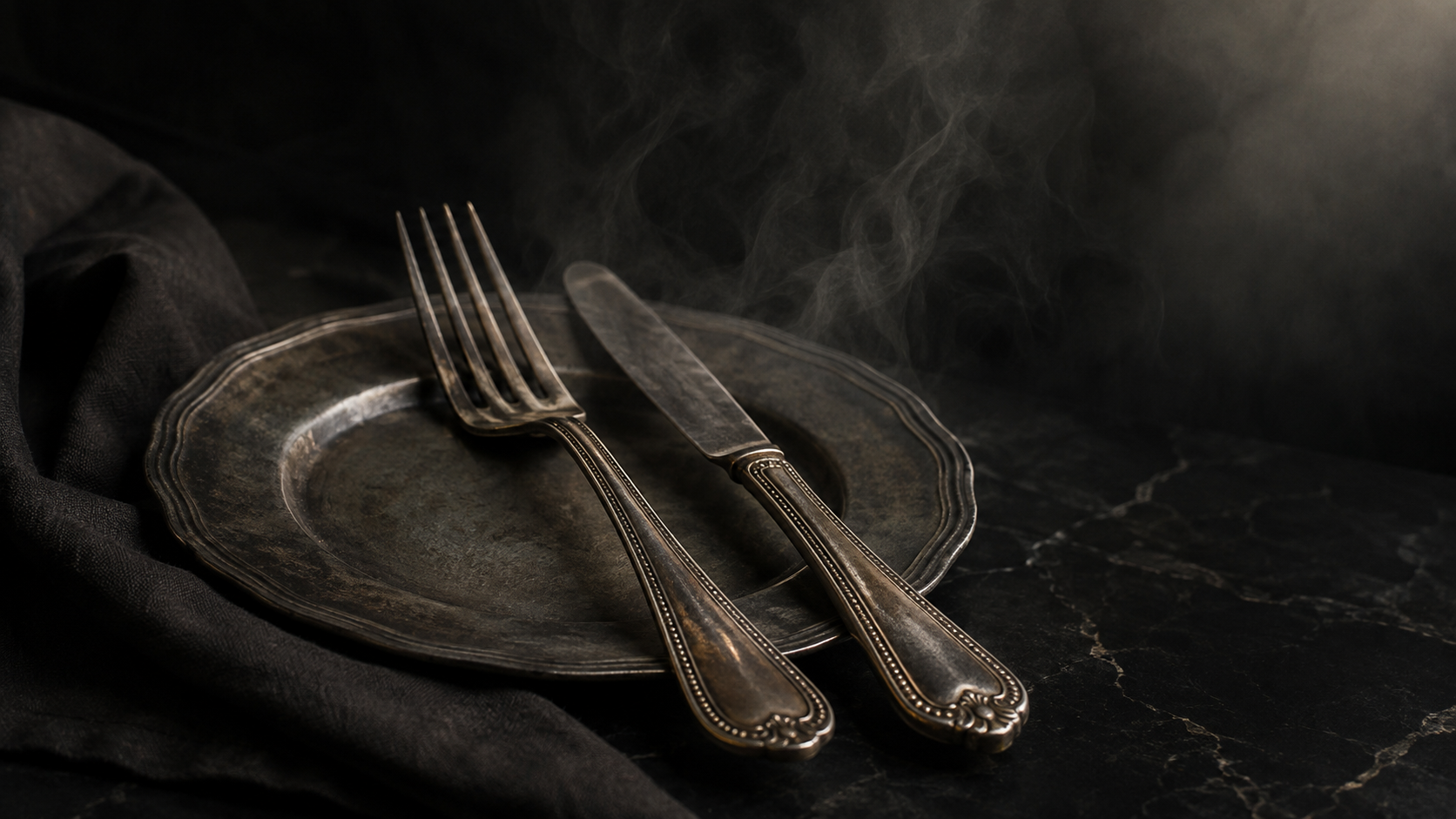
Silver does not need to touch food or hands to darken: slow exposure to sulfur gases present in the environment is enough. This guide explains what forms on the surface, why the color changes, and what tarnishing reveals—and what it does not.
Quick answer: silver reacts with the environment, not with use
Silver can darken inside a drawer because it remains in contact with the air. Traces of gases containing sulfur react with the surface and form, primarily, silver sulfide. Humidity, the concentration of those gases, and certain materials in the case can accelerate the process. The fact that a piece turns black does not, by itself, prove that it is fake, antique, or poorly cared for.
Four key facts to understand tarnishing
| Question | Verified Answer |
|---|---|
| What reacts? | The silver surface with sulfur gases present in the environment. |
| What is formed? | Primarily silver sulfide (Ag2S); in sterling silver, copper sulfide can also appear. |
| Does it need to be used? | No. The reaction can progress during storage. |
| What accelerates it? | More sulfur gases, higher humidity, and inadequate storage materials. |
Silver does not darken due to lack of use: it reacts with the environment
Opening a case that has been closed for months and finding the flatware darker seems like a contradiction: no one touched them, they were not near food, and yet, they lost their shine. The explanation is simple. Storing a piece reduces some contact, but it does not necessarily separate it from the air or the materials surrounding it.
The usual change is not accumulated dirt nor the reddish rust characteristic of iron. It is a film of chemical alteration that forms when silver comes into contact with sulfur compounds. The Canadian Conservation Institute describes this phenomenon as a reaction with sulfur-containing gases present in the air.
Therefore, the correct question is not "who used the piece?", but rather "what atmosphere was it exposed to?". A flatware set can remain motionless and continue to react slowly with its microenvironment.
The darkness of silver does not count how many times it was used; it counts, above all, what air and what materials it lived with. — Mesa Real House Editorial
What forms on the surface: silver sulfide
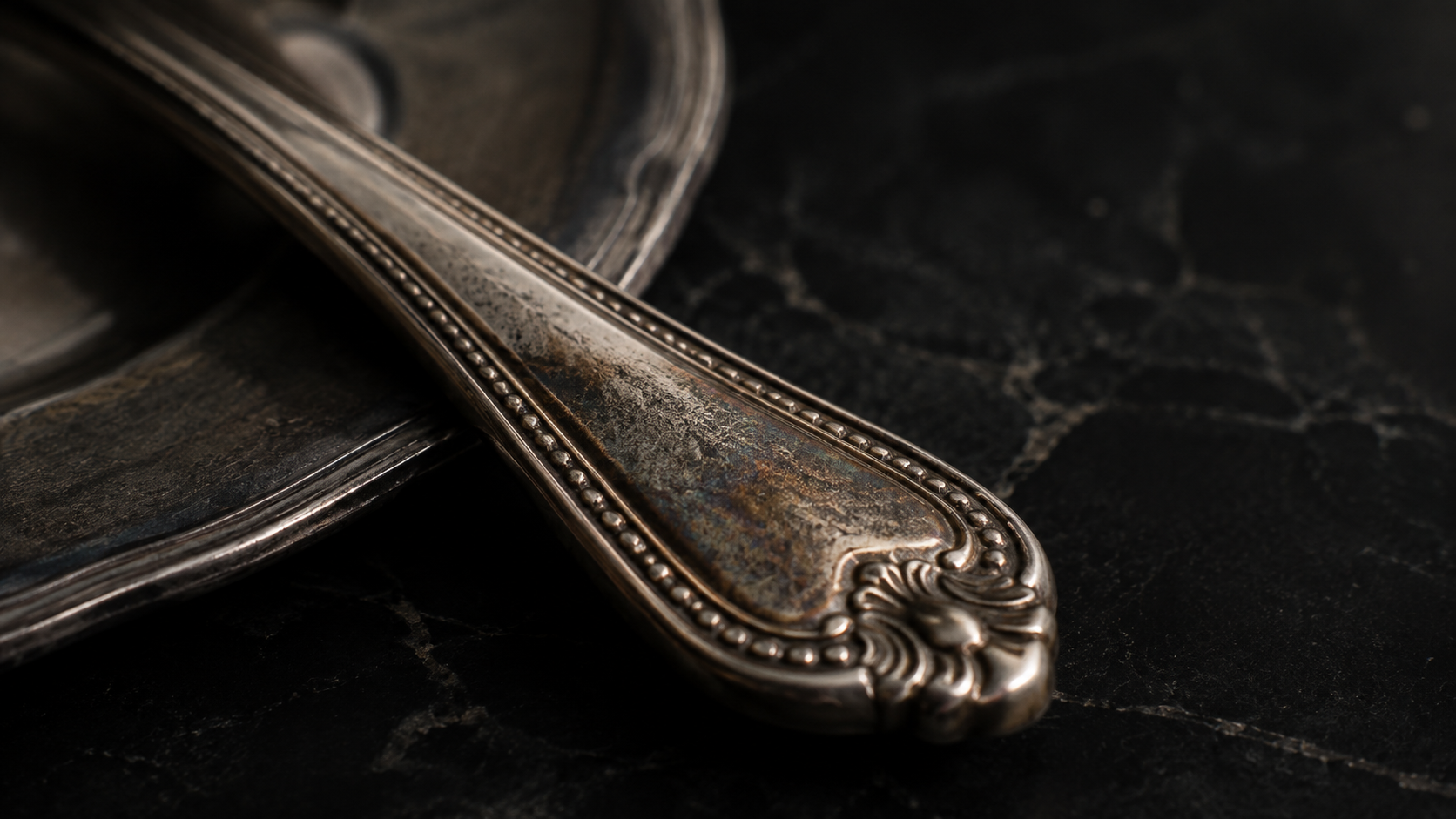
In pure silver, the blackening layer is mainly composed of silver sulfide, whose formula is Ag2S. In sterling silver —the alloy usually identified as 925 silver— the film may also contain copper sulfide, because the metal incorporates copper to modify its mechanical properties.
The reaction occurs on the surface. At first, the film is extremely thin and can be almost imperceptible. As it grows, it changes the way light reflects and the piece loses the uniform appearance of a recent polish.
This definition coincides with the terminology of the Art & Architecture Thesaurus of the Getty Research Institute, which describes tarnish as a discolored surface film produced by chemical deterioration and cites silver sulfide as a common example on silver.
Why silver can look yellow, reddish, bluish, and finally black
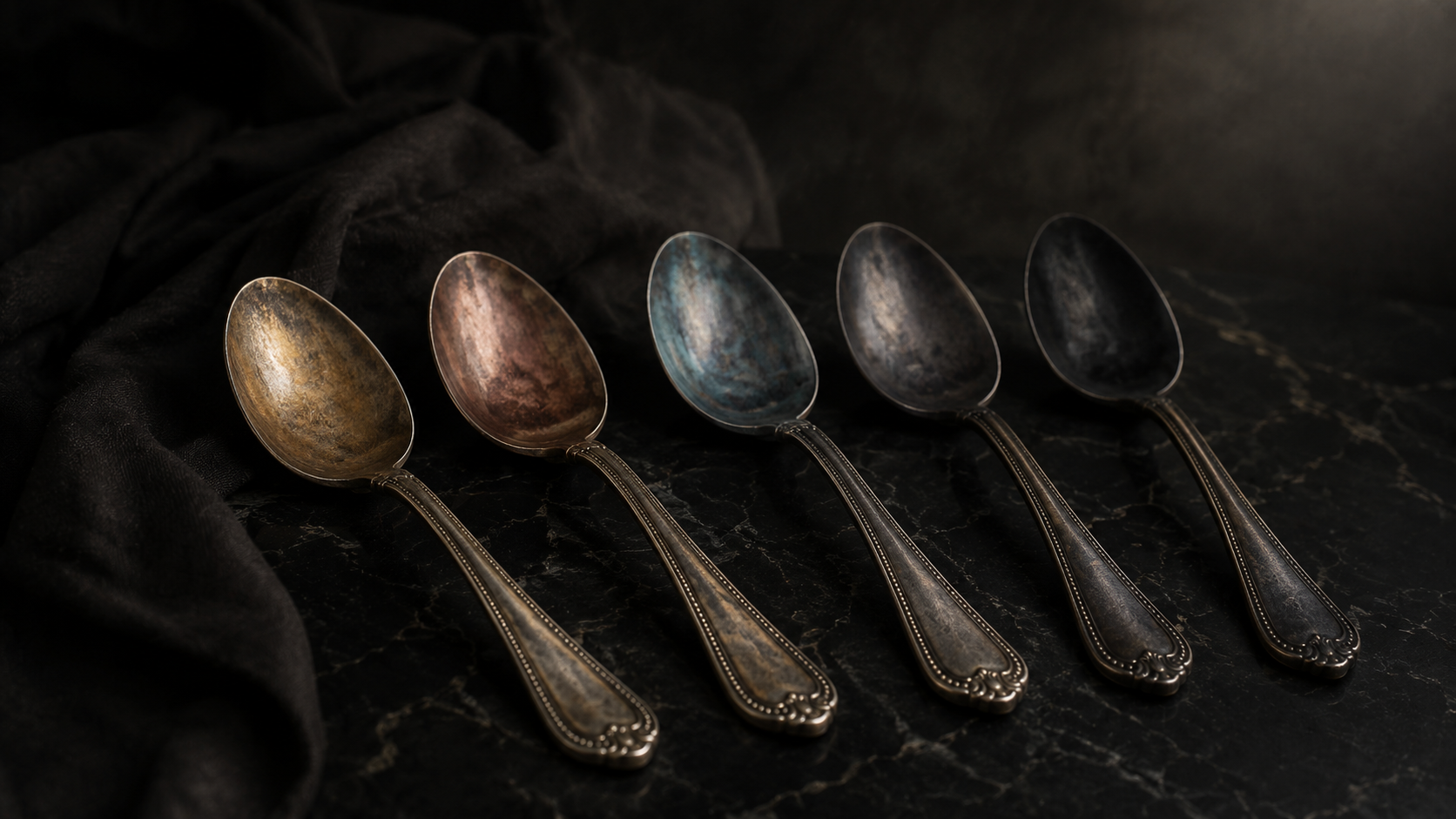
Tarnishing doesn't always start with black. A very thin film can produce yellow, gold, reddish, brown, or bluish tones. The reason is thin-film interference: part of the light reflects off the surface of the layer and another part reaches the metal underneath. Both reflections combine and generate different colors depending on the thickness.
As the layer continues to grow, the interference colors give way to a dark brown or black appearance. This sequence explains why two pieces stored together may look different: one might be in an earlier phase, have a different composition, or have been exposed to a different concentration of gases.
Important: The color does not allow for an accurate calculation of the piece's age or the exact storage time. It only shows that the surface film has a different condition or thickness.
How it can tarnish inside a drawer or a closed case
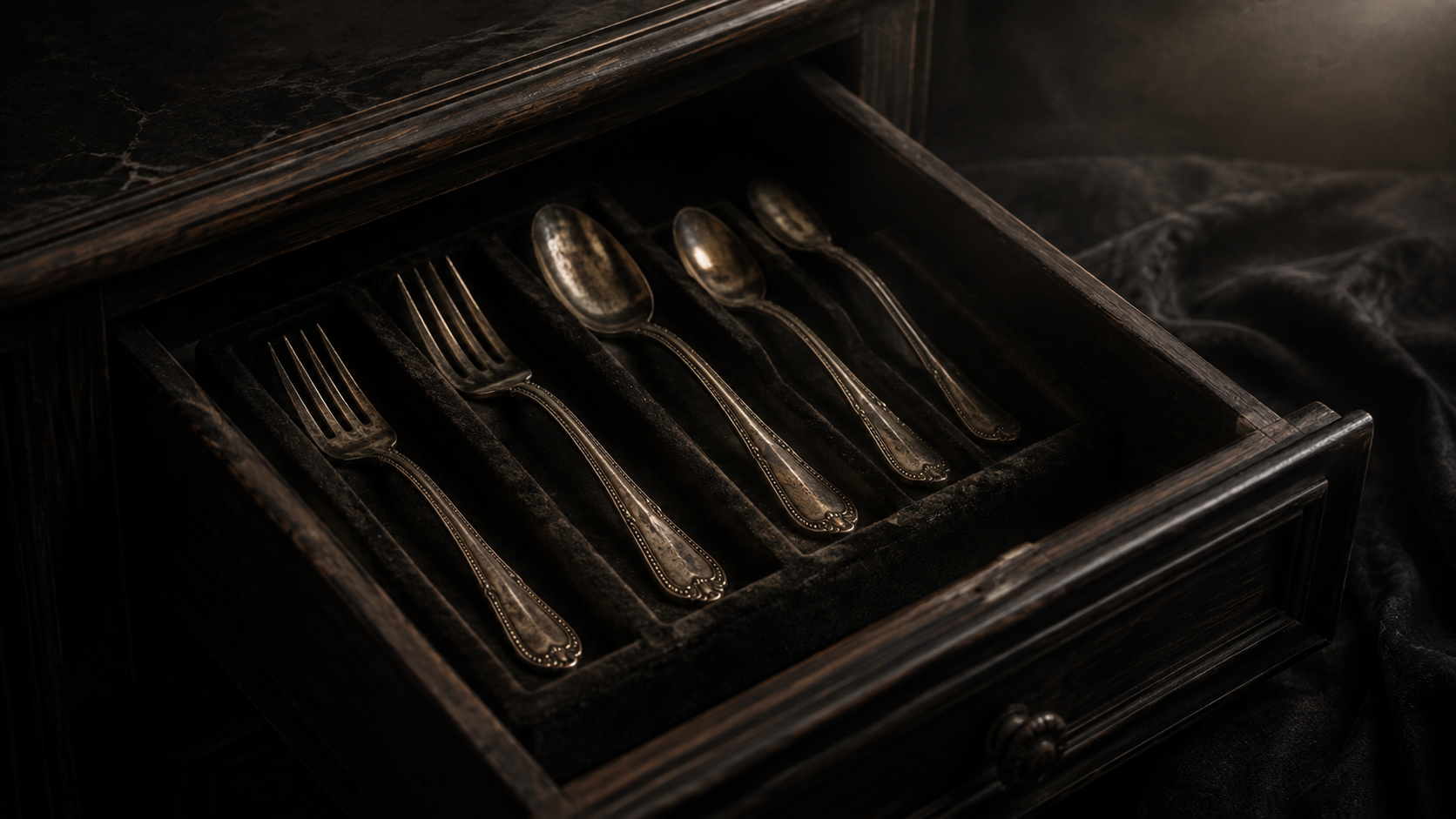
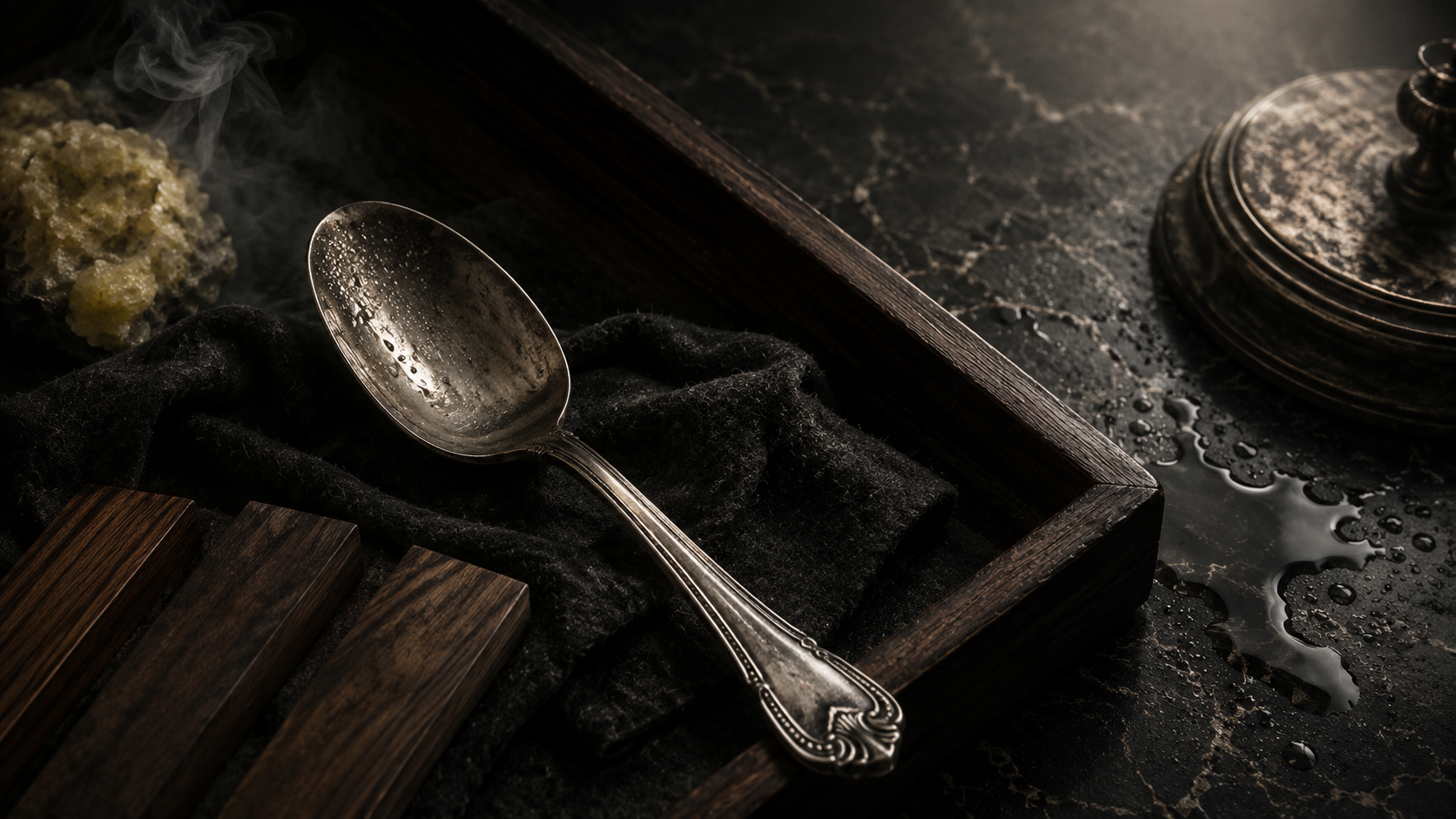
A closed drawer is not an airtight chamber. It usually contains oxygen, moisture, and very small amounts of volatile compounds. Furthermore, the interior itself can emit substances that promote tarnishing. An imperfect seal allows for exchange with the room, while a very tight seal can concentrate emissions coming from unsuitable materials.
Among the sources that conservation specialists associate with gases or contaminants capable of affecting silver are:
- vulcanized rubbers and gums, including latex;
- wool, felt, and some textiles;
- certain paints, adhesives, and packaging materials;
- low-quality paper or cardboard and some wood-derived products;
- foods rich in sulfur compounds, such as eggs, when stored nearby;
- atmospheric pollutants and dust that retains moisture.
This does not mean that every antique case is harmful or that each of these materials causes the same effect. Composition, age, ventilation, and proximity determine how much a material emits. For valuable pieces, the compatibility of the case must be evaluated separately.
The four factors that most influence speed
1. The concentration of sulfur gases
The higher the concentration of reactive compounds around the piece, the greater the probability that the film will grow rapidly. This is why a nearby source can carry more weight than whether the flatware is left out or stored away.
2. Relative humidity
For a comparable concentration of hydrogen sulfide, tarnishing accelerates as relative humidity increases. Humidity does not "create" the sulfide on its own, but it facilitates the reaction conditions. This is one of the reasons why the same set can be preserved differently in two different homes.
3. Case and Cabinet Materials
A soft lining is not automatically inert. Felts, rubbers, adhesives, cardboards, paints, or woods can release compounds for years. The Canadian Conservation Institute recommends chemically stable storage materials to reduce risks to metals.
4. Surface Condition
In conservation observations, a freshly polished surface may tarnish faster than one that already possesses a stable film. This fact is counterintuitive, although it does not turn the blackening into a protection that should always be preserved. In a domestic, museum, engraved, or silver-plated piece, the decision to clean depends on the condition, use, and value of the surface.
Do Pure Silver, Sterling Silver, and Silver Plate Behave the Same?
| Type of Piece | What Can Tarnish | What Should Be Checked |
|---|---|---|
| High-Purity Silver | The silver surface itself can form silver sulfide. | Hallmark, documentation, and possible welds or decorations. |
| Sterling Silver (925) | Silver sulfide can form and, due to the presence of copper, copper sulfide as well. | 925 hallmark, maker's mark, and polish condition. |
| Silver Plate | The outer silver layer can also tarnish. | Thickness and condition of the plating; do not assume it allows for repeated polishing. |
Purity influences the composition of the film but does not immunize against the environment. Both solid silver and a silver-plated surface can lose their luster. To compare designations before purchasing, explore the Mesa Real flatware selection and the sterling silver flatware filter; the exact material should always be confirmed in the specifications of each reference.
Does Turning Black Prove That Silver Is Authentic?
No. Tarnishing is compatible with authentic silver, but it does not serve as sufficient proof of authenticity. A piece of solid silver can darken, but so can a silver-plated object. Even other metals or finishes can develop different dark films.
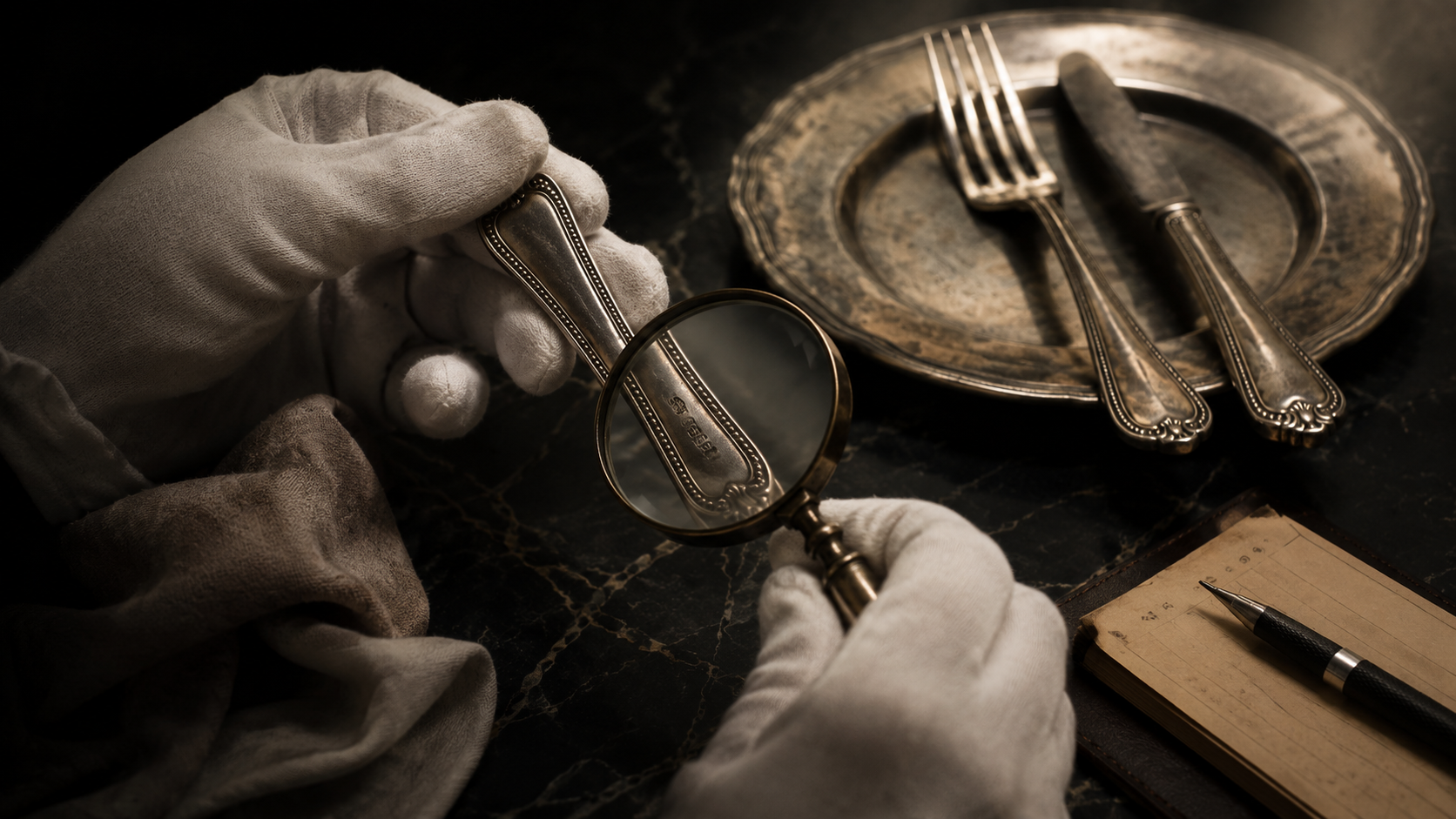
Responsible identification is based on hallmarks, declared fineness, manufacturer, construction, documentation and, when the value justifies it, professional analysis. The Mesa Real guide on flatware, glassware, and porcelain as heritage assets explains why traceability matters more than an isolated visual impression.
You can also consult the houses present at Mesa Real and our space on master artisans to place each piece within a documentable manufacture and tradition.
This article addresses the cause of tarnishing. The choice of a cleaning method requires another evaluation: modern solid silver flatware does not necessarily pose the same risks as a silver-plated, engraved, antique, gilded piece, or one combined with wood, ivory, or other materials.
The safest principle is to avoid repeated or aggressive interventions. The Canadian Conservation Institute warns that every mechanical or chemical removal of tarnish removes some silver, a risk especially relevant when only a silver-plated layer exists.
Before cleaning, document five pieces of information
- visible hallmarks, marks, and numbers;
- whether the piece is solid, silver-plated, or of uncertain composition;
- presence of gilding, engraving, niello, intentional patina, or joined parts;
- photographs of the complete condition and the darkest areas;
- official manufacturer instructions or a conservator's recommendation.
When a reliable data sheet does not exist or the piece has family, historical, or economic value, request personalized advice or use the contact page before applying home remedies.
Conclusion: The drawer stops usage, not chemistry
Silver tarnishes without being used because storage does not always isolate it from sulfur gases. These compounds react with the surface and form a film whose color changes as its thickness increases. Humidity and nearby materials can accelerate the process.
Blackening does not certify authenticity, antiquity, or neglect. It is a superficial sign that must be interpreted alongside the hallmark, composition, and conservation context. Before restoring the shine, it is advisable to understand what piece you have in front of you and how much metal may be lost with each intervention.
Frequently asked questions about silver that tarnishes while stored
Why does silver turn black inside a box?
Because the box contains air and can concentrate gases emitted by the environment or by its own materials. These compounds react with the surface and form, primarily, silver sulfide.
Does .925 sterling silver tarnish even if it is never used?
Yes. 925 silver contains silver and copper; its surface can form silver sulfide as well as copper compounds. Lack of use does not prevent environmental reaction.
Does humidity turn silver black?
Humidity is not the sole cause, although it can accelerate the process when sulfur gases are present. At the same concentration of hydrogen sulfide, the rate of tarnishing increases with relative humidity.
Does a felt case always provide protection?
Not necessarily. Some felts, wools, adhesives, or materials in the case can emit harmful compounds. Mechanical softness does not guarantee chemical stability.
Does a piece darkening mean it is real silver?
It is not a sufficient test. Both solid silver and silver-plated objects can darken. Authenticity requires hallmarks, documentation, and, when appropriate, specialized analysis.
Does using the flatware prevent it from darkening?
It does not function as chemical protection. Washing and drying can make an incipient film less visible, but a piece that is used can also react with sulfur compounds.
Should it be polished every time a spot appears?
Not automatically. Removing tarnish takes away some silver and can damage thin plating, details, or patinas. The piece must first be identified and a compatible method chosen.
Continue exploring silver and the high table
- Premium flatware sets and pieces
- 925 sterling silver flatware filter
- How to document heritage-use tableware pieces
- More guides from the Mesa Real journal
- Back to Mesa Real
Sources consulted and editorial criteria
Mesa Real cross-referenced chemical and conservation claims with government documentation and museum terminology. Recommendations are general; the composition and instructions of the specific reference prevail.
- Canadian Conservation Institute — Understanding how silver objects tarnish
- Canadian Conservation Institute — Silver: Care and Tarnish Removal
- Canadian Conservation Institute — Storage of Metals
- Getty Research Institute — Art & Architecture Thesaurus: tarnish
Do you wish to identify or complete a sterling silver flatware set?
Send us photographs of the hallmarks, the case, the number of pieces, and any damaged areas. Mesa Real can help you organize the information, distinguish material inquiries from conservation ones, and search for compatible references without promising an attribution that cannot be documented.
Explore 925 sterling silver · Request advisory services · Contact Mesa Real