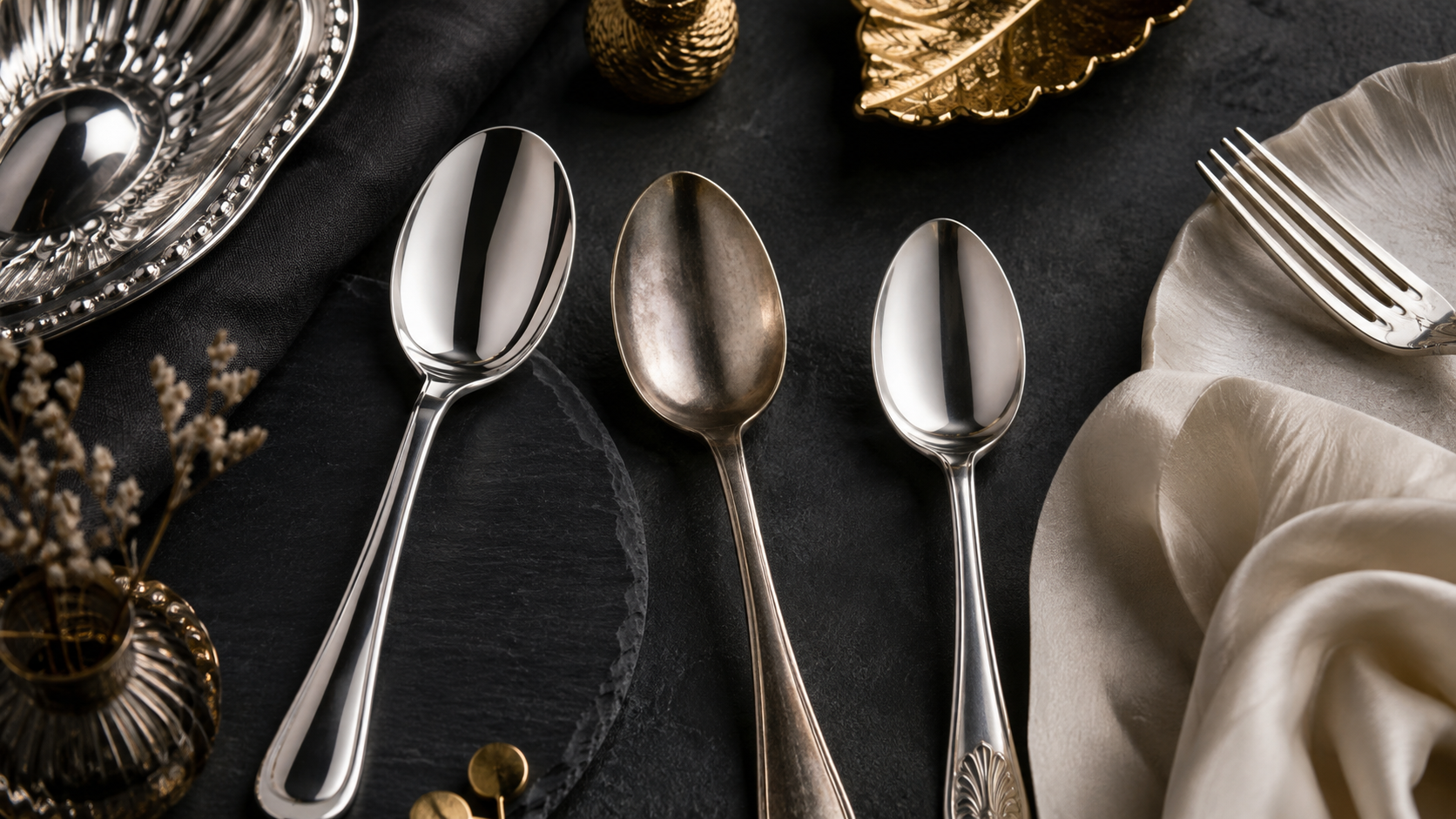
Silver, nickel silver, and silver plate may share a similar luster, but they do not describe the same composition. Sterling silver is a precious alloy whose fineness must be documented; nickel silver is an alloy of copper, nickel, and zinc with no silver by definition; and “silver-plated” describes a silver surface applied over a core that can vary.
The difference is not merely terminological. It changes what you are buying, the correct way to interpret hallmarks, the potential surface wear, future restoration, and how the price should be compared. Therefore, a shiny photograph or an imprecise description is never enough to identify a piece.
The difference in less than a minute
Sterling silver: An alloy with a declared proportion of silver; “925” expresses 925 parts of silver per thousand when that standard is applicable and authentic. Nickel silver: An alloy of copper, nickel, and zinc that mimics the color of silver but contains no silver by definition. Silver plate: A base metal object coated with a layer of silver; the core can be nickel silver, brass, or another metal.
Three names, three material realities
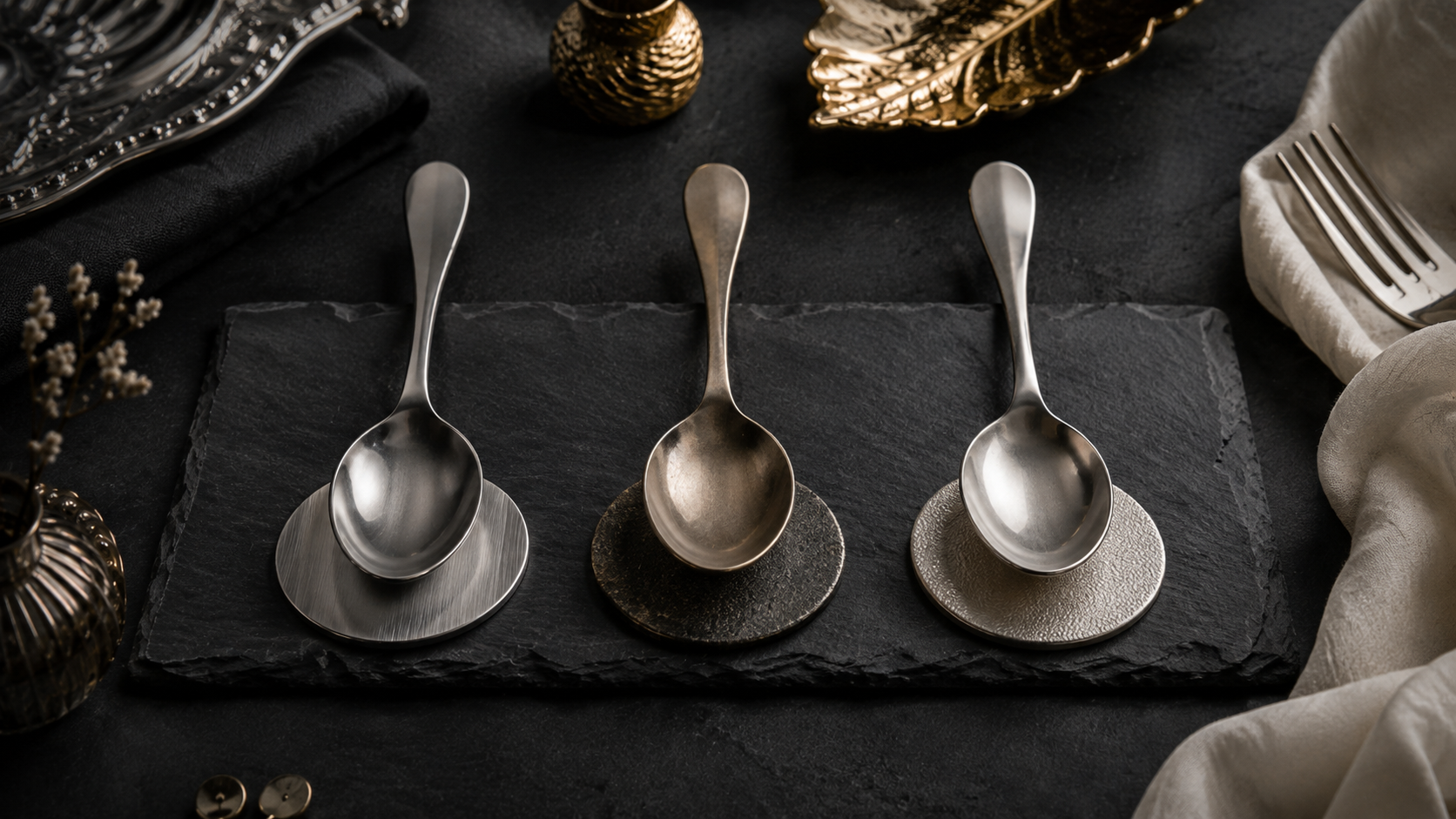
Sterling silver
Precious alloy. The fineness figure indicates how many parts of silver it contains per thousand, provided the marking is authentic and corresponds to the applicable system.
Nickel Silver
An alloy of copper, nickel, and zinc. It may also appear as nickel silver, German silver, or white metal, depending on the language and historical context.
Silver Plate
A base metal coated with silver. The term describes the outer layer; it does not, by itself, identify the core metal or the amount of silver applied.
The essential comparison: composition, not appearance
The silver color is an appearance. It does not prove that a piece is solid silver, sterling silver, or that it possesses a certain fineness. A well-polished nickel silver flatware set, a newly restored silver-plated piece, and a sterling silver piece can look very similar under the same lighting.
| Material | Basic Composition | What the name describes | What should be verified |
|---|---|---|---|
| Sterling silver | Silver combined with other metals to form a usable alloy. | The composition of the body of the piece. | Fineness, hallmark or punch, maker, provenance, and documentation. |
| Nickel silver | Copper, nickel, and zinc in varying proportions. | A family of base metal alloys with a silver-like appearance. | Exact name of the alloy, manufacturer, possible coating, and condition. |
| Silver plate | A base metal core covered by a layer of silver. | The surface treatment, not necessarily the interior metal. | Base metal, plating method, manufacturer specification, wear, and restorations. |
Shine may guide the eye; composition, hallmarks, and documentation are what support a responsible identification. Mesa Real · materials editorial criteria
What is sterling silver and what does 925 mean
Pure silver is too soft for many everyday uses, so it is usually combined with other metals. In systems that recognize the sterling designation, the 925 mark expresses a fineness of 925 parts of silver for every thousand parts of the alloy. The British Hallmarking Council [3] guide explains that fineness is expressed in parts per thousand and that a full hallmark provides additional information beyond a simple number.
This leads to an important rule: “925” is an indication of fineness, not a standalone guarantee of authenticity. In a significant purchase, it is advisable to observe the marking as a whole, its consistency with the manufacturer, the provenance, and the documentation. An isolated, blurry, or subsequently added stamp should be treated as a sign that requires confirmation.
Furthermore, not every piece generically described as “silver” has to be 925. There are other finenesses, national systems, historical periods, and technical uses. The correct description should indicate the specific fineness when known, rather than using “silver” as a universal synonym for “925 silver.”
“Solid silver” does not necessarily mean pure silver
In trade, “solid” usually differentiates a piece whose body is a silver alloy from one that only has a silver-plated layer. It does not mean that the object is manufactured with chemically pure silver. Therefore, the fineness remains an essential piece of data.
What is nickel silver: the most confusing name
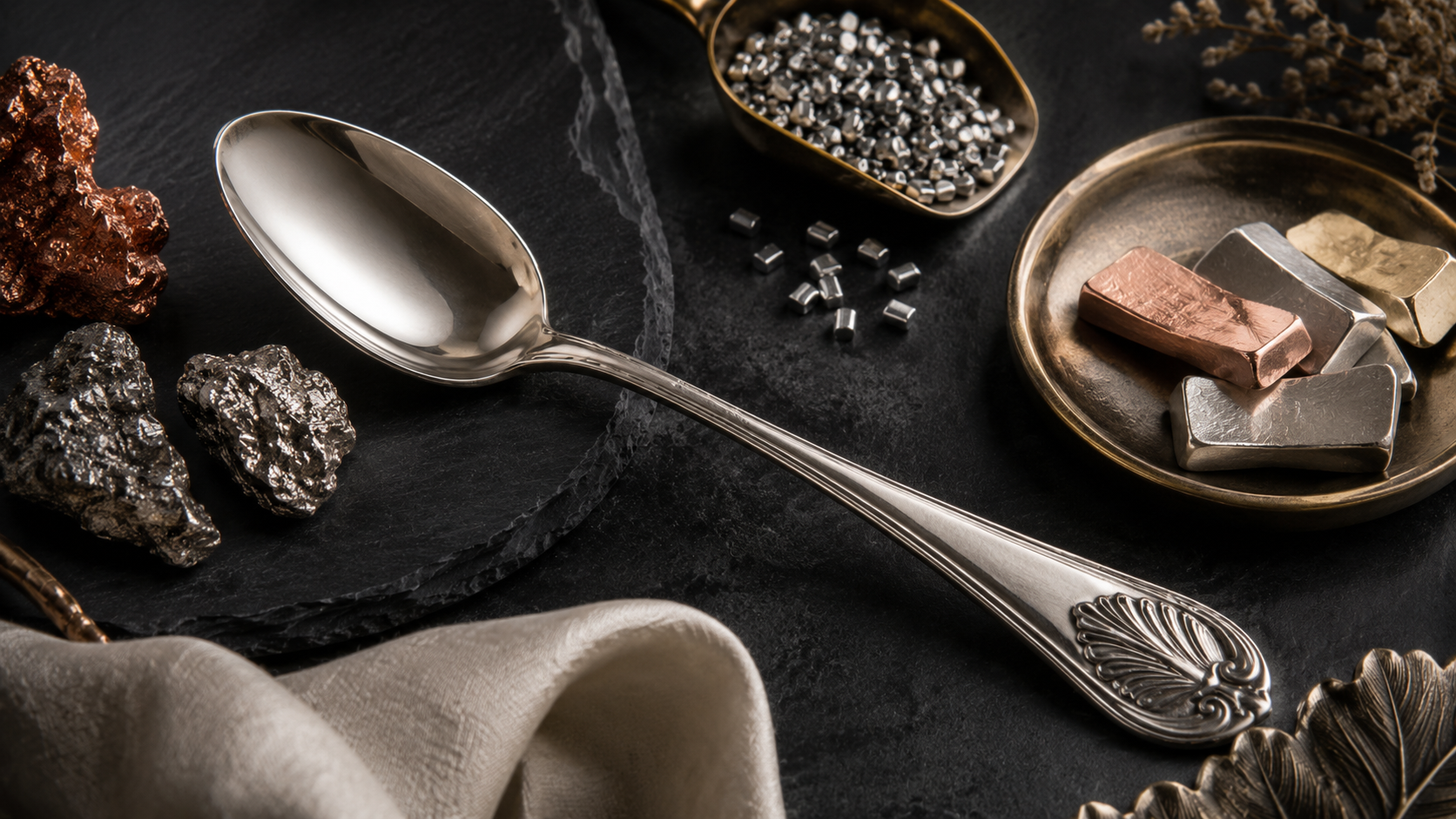
Nickel silver is an alloy of copper, nickel, and zinc. The Cultural Heritage Thesaurus of Spain [1] defines it as an alloy of these three metals, with a color varying between pale tones and silver-gray, historically used to imitate silver. The technical family of so-called nickel silvers is also classified as copper-nickel-zinc by the Copper Development Association [2].
The decisive point is simple: nickel silver contains no silver by definition. The terms nickel silver or German silver refer to its appearance, not to the presence of the precious metal. Therefore, a description that only says "German silver" can be confusing for a buyer who is unfamiliar with the term.
Nickel silver can serve as a base metal for silver plating. In that case, the precise description would be "silver-plated nickel silver" or an equivalent formulation backed by the manufacturer's data sheet. The piece does not become solid silver: it continues to have a nickel silver core and a silver surface.
Nickel silver does not automatically equate to poor quality
Material composition and quality of execution are distinct dimensions. A nickel silver piece may be of interest due to its design, manufacturing, age, authorship, or preservation. What should not happen is for it to be valued as sterling silver when it is not. Transparency in the description protects both the buyer and the seller's reputation.
What is silver plate: a layer, not a defined core
“Silver plate” describes a base metal object coated with silver. The core can be nickel silver, brass, or another alloy; the term alone does not reveal which. Official British guidance on descriptions of silver-plated articles [4] reinforces the need to clearly differentiate between solid precious metal and plating.
The amount of silver applied cannot be deduced from a photograph. Some houses document the method or a specific proprietary specification; other antique pieces require reviewing catalogs, hallmarks, and context. Figures such as 20, 40, 90, or 100 grams belong to a separate technical topic and should not be interpreted without knowing the system, the number of pieces, and the manufacturer's convention.
With use, a silver-plated layer can thin in contact areas: tips, edges, reliefs, or resting points. If a different tone appears underneath, it may be a sign of coating wear, although the color of the core alone does not identify its alloy. A previous restoration can also alter what is visible.
“Silver-colored” should not just mean “silver-plated”
In a rigorous description, it is advisable to separate three concepts: color, material, and finish. “Silver color” may refer only to appearance; “silver-plated metal” should indicate an actual coating; and “sterling silver” refers to the composition of the alloy. Mixing them creates wrong expectations.
How to distinguish them without damaging the piece
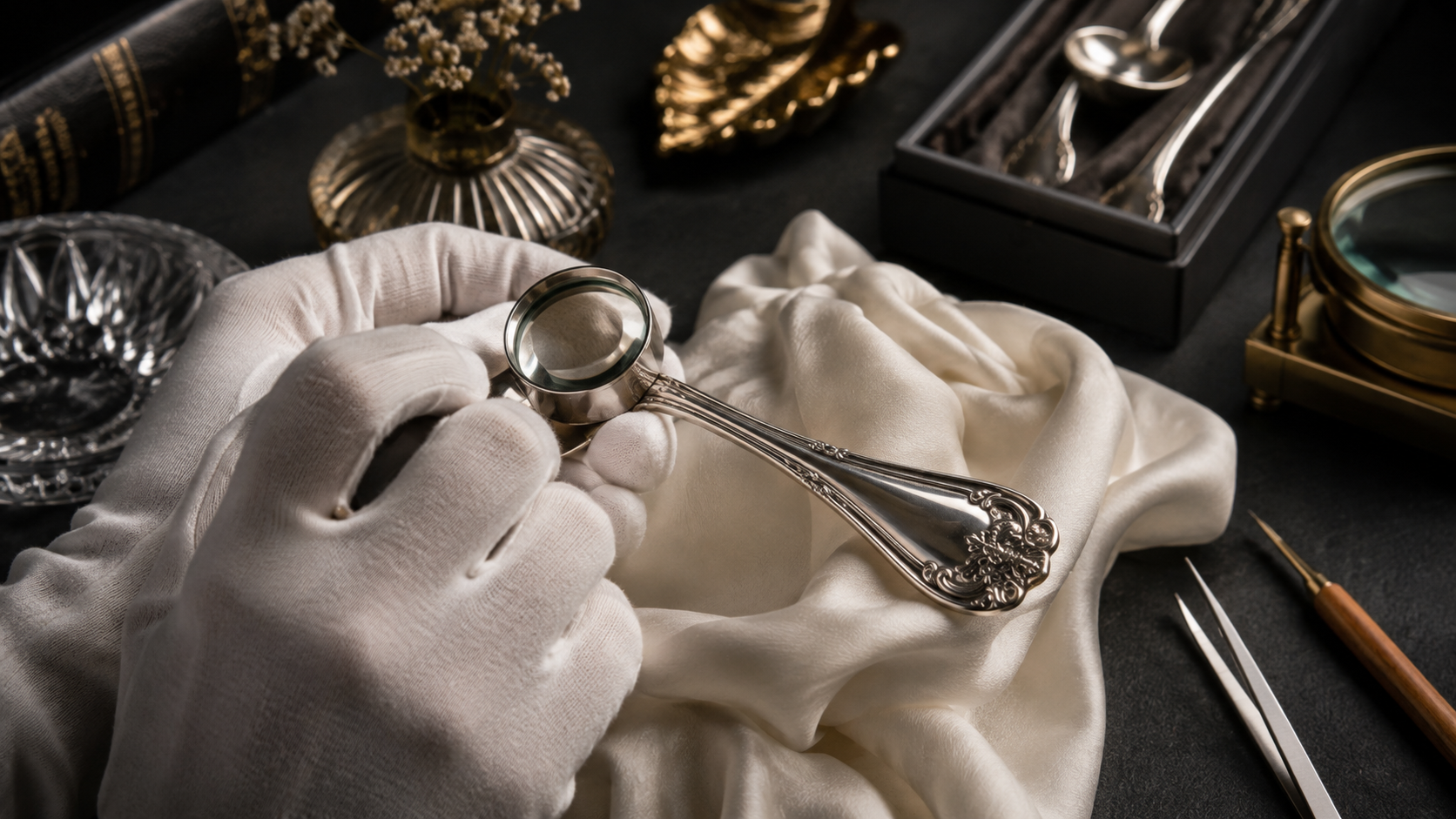
Responsible identification progresses from the least invasive to the most specialized. It is not advisable to start with acids, scraping, filing, or viral internet methods: they can damage a surface, erase historical evidence, or reduce the value of a piece.
CHECKLIST
Five steps before drawing conclusions
- Read the full description. Look for body material, fineness, plating, manufacturer, collection, and country of origin.
- Photograph all marks. Include hallmarks, symbols, initials, numbers, and their location, using side lighting and without pre-polishing.
- Observe the wear. Check edges, tines, resting points, and reliefs; a color difference may indicate a surface layer, but it does not identify the core on its own.
- Compare with reliable documentation. Manufacturer catalogs, archives, invoices, certificates, or institutional databases are more solid than a visual match on a marketplace platform.
- Request professional analysis when it matters. For a high-value purchase, an inheritance, or a doubtful attribution, the test must be performed by a specialist using a proper and documented method.
What a magnet can and cannot tell you
Magnetic response is, at most, a clue. A piece may combine different materials in the blade, handle, solder, reinforcement, or core. Furthermore, the absence of attraction does not prove it is sterling silver. Using a magnet as a verdict transforms a partial observation into an unjustified conclusion.
Weight, sound, and color: useful for comparison, insufficient for certification
Weight depends on size, thickness, construction, and the presence of fillers. Sound changes with shape and assembly. Color can be altered by patina, polishing, lighting, or restoration. These traits help detect inconsistencies between pieces of the same set, but they do not replace marking or competent analysis.
How to read marks and descriptions without falling for false certainties
A mark must be interpreted as part of a system. The same number can have different meanings out of context, and a commercial word can vary between languages. This table offers initial guidance, not certification.
| Mark or term | What it usually indicates | What it does not prove on its own |
|---|---|---|
| 925 / Sterling | Fineness of 925 parts of silver per thousand in systems that recognize that standard. | Authenticity of the stamp, manufacturer, age, or absence of repairs. |
| Alpaca / Nickel silver / German silver | Alloy of copper, nickel, and zinc with a silver-like appearance. | Silver content. |
| Silver plated / Plateado / Bañado en plata | Silver coating over a base metal. | Core metal, amount applied, or current state of the layer. |
| House name | Possible manufacturer, distributor, or commercial brand. | Material of each specific reference. |
| Model or series numbers | Internal identification, size, batch, or production convention. | Fineness, unless confirmed by manufacturer documentation. |
When a publication mixes expressions like “silver nickel silver,” “silvered silver,” or “925 German silver” without explaining the composition, request a written clarification. A good response should distinguish the base metal, the plating, and the fineness, rather than repeating the same ambiguous term.
Seven common mistakes when identifying a piece
- Believing that everything shiny is silver. Polishing and plating can produce very similar appearances.
- Interpreting “German silver” literally. It is a historical name for nickel silver, not a guarantee of silver content.
- Confusing silver plate with a single material. The expression refers to the surface; the core can vary.
- Relying only on a magnet. Construction can combine metals, and a lack of magnetism does not certify silver.
- Taking an isolated number as definitive proof. The hallmark must be consistent with the rest of the marks and the applicable system.
- Assuming the brand determines the material. The same house can produce lines in silver, silver-plated, and steel.
- Equating metal value with total value. Design, authorship, rarity, condition, provenance, and demand can also influence value; no general guide replaces a specific appraisal.
Sterling silver, nickel silver, or silver plate: which is best depending on use
There is no universal winner. The decision depends on what you value and what the seller can document. The most expensive material does not compensate for a confusing description, just as a base metal does not invalidate a well-designed and honestly presented piece.
| Priority | Option worth studying | Key check |
|---|---|---|
| Precious material and documented fineness | Sterling silver | Hallmark, fineness, provenance, condition, and consistency between all pieces. |
| Silver aesthetic with less dependence on precious metal value | Nickel silver or silver plate | Clearly differentiate solid alloy from plating and check for wear. |
| Historical, artisanal, or specific house design | Any of the three, depending on the reference | Authorship, catalog, construction, restorations, and set consistency. |
| Frequent use and future replacement | The collection with the best documentation and availability | Care instructions, open stock pieces, after-sales service, and suitability for actual use. |
| Purchase for a gift or registry | The option whose composition can be explained without ambiguity | Technical specifications, presentation, replacement policy, and total budget. |
To compare current options without turning this informative article into a sales page, consult the Mesa Real flatware selection. Those specifically looking for references classified by material can use the 925 silver filter. The availability and the data sheet of each product are what must prevail over any general explanation.
What to ask before buying flatware
A precise inquiry reduces more risk than a long string of adjectives. Before deciding, request concrete answers and keep the information in writing.
- What is the body material of each piece?
- Is it sterling silver, uncoated nickel silver, or silver plate?
- If it is sterling silver, what is the fineness and what hallmark does it possess?
- If it is silver-plated, what is the base metal and what specification does the manufacturer provide?
- Do all pieces belong to the same set, period, and material?
- Are there repairs, replating, removed monograms, or areas with wear?
- Is there an invoice, certificate, original box, catalog, or verifiable reference?
- Can pieces be replaced and what are the care instructions for that reference?
It is also useful to review the houses and manufacturers present at Mesa Real, because the same brand may work with different materials depending on the collection. For an inherited piece, a significant purchase, or a contradictory description, request personalized advice or send an inquiry with photographs of all hallmarks.
The Mesa Real criteria: naming exactly what is being sold
Trust begins with a specification sheet that separates material, fineness, finish, and color. Mesa Real does not consider “silver,” “nickel silver,” and “silver-plated” to be interchangeable. When a specification is not confirmed, the responsible approach is to indicate it and avoid a categorical conclusion.
This approach also protects the buyer against two extremes: paying a premium for a non-existent composition or discarding a base metal piece that does possess merit due to its design and manufacturing. In both cases, the decision improves when the information is verifiable.
BUYING RULE
- First, identify the composition.
- Next, check the hallmarks and documentation.
- Then, evaluate condition, design, replacement availability, and intended use.
- Only at the end, compare the price with truly equivalent pieces.
The conclusion that avoids most confusion
Sterling silver, nickel silver, and silver plate are not three grades of the same thing. The first is a precious alloy with a specific fineness; the second is an alloy of copper, nickel, and zinc; and the third is an object whose base metal is covered by silver. A piece can combine nickel silver and silver plating, but that does not make it solid silver.
When the material influences the price, preservation, or history of the object, do not buy an appearance: buy a coherent description, legible hallmarks, and sufficient documentation. To continue deepening your knowledge of tableware materials, visit the Mesa Real journal, the guide on glass or crystal, and the comparison between bone china and porcelain.
FREQUENTLY ASKED QUESTIONS
Common questions about silver, nickel silver, and silver plate
Does nickel silver contain silver?
Not by definition. Nickel silver (alpaca) is an alloy of copper, nickel, and zinc. It can receive a silver coating, in which case it should be described as silver-plated nickel silver or with an equivalent formulation backed by the manufacturer's data sheet.
Are nickel silver and silver plate the same thing?
No. Nickel silver identifies a body alloy; silver-plated identifies a layer of silver over a base metal. A piece can be uncoated nickel silver or silver-plated nickel silver.
What does 925 mean on a piece?
In systems that recognize this standard, it indicates a fineness of 925 parts of silver for every thousand parts of alloy. The figure must be interpreted alongside the rest of the hallmark, the provenance, and the documentation; an isolated stamp does not certify authenticity on its own.
Can a silver-plated piece have nickel silver underneath?
Yes. Nickel silver has been used as one of the possible base metals for silver-coated pieces. Other cores may also exist, so the exact composition should be consulted in the documentation or professionally verified.
Does a magnet allow you to know if a piece is silver?
Not conclusively. A piece may combine materials in the blade, handle, solders, or reinforcements, and a lack of attraction does not prove it is sterling silver either. A magnet offers, at most, a partial indication.
How to know if a piece is solid silver?
Check the fineness, the full hallmark, the maker's mark, consistency with catalogs, and provenance. If the result has economic, heritage, or restoration consequences, request a professional non-destructive or properly documented verification.
What does it mean if another color appears beneath the surface?
It may indicate wear of a plating, a repair, or a difference in material between components. The visible tone does not reliably identify the core alloy; it must be evaluated alongside the marks and construction.
Is German silver actually silver?
The term is typically used as a historical synonym for nickel silver or alpaca, an alloy of copper, nickel, and zinc. The name refers to its silvery appearance and does not demonstrate silver content.
Is sterling silver always worth more?
Its precious metal content can provide a material value component, but the total price of a piece may also depend on design, manufacturer, rarity, condition, provenance, and demand. It is not responsible to value a specific piece based solely on the name of the material.
SOURCES CONSULTED
Institutional and technical references
- Ministerio de Cultura de España — Tesauro del Patrimonio Cultural: Alpaca.
- Copper Development Association — Wrought nickel silvers: copper-nickel-zinc alloys.
- British Hallmarking Council — Hallmarking guidance summary.
- GOV.UK — Silver plate and gold plate notice.
External links focus on definitions and technical criteria, originate from institutional or technical entities, and do not lead to competing retailers. Legal hallmarking rules may vary by jurisdiction.
RELATED READINGS
More guides for informed purchasing
- How the value of a tableware piece is formed beyond the material
- Crystal or glass: how to distinguish them and when it matters
- Bone china vs. porcelain: differences in composition and use
- The art of entertaining: pieces, proportion, and criteria at the table
SELECTION AND ADVICE
Compare materials with a clear guide
Explore the available flatware and review the declared composition in each reference. If a legacy piece or an external publication presents contradictory markings, send legible photographs before making a decision.